

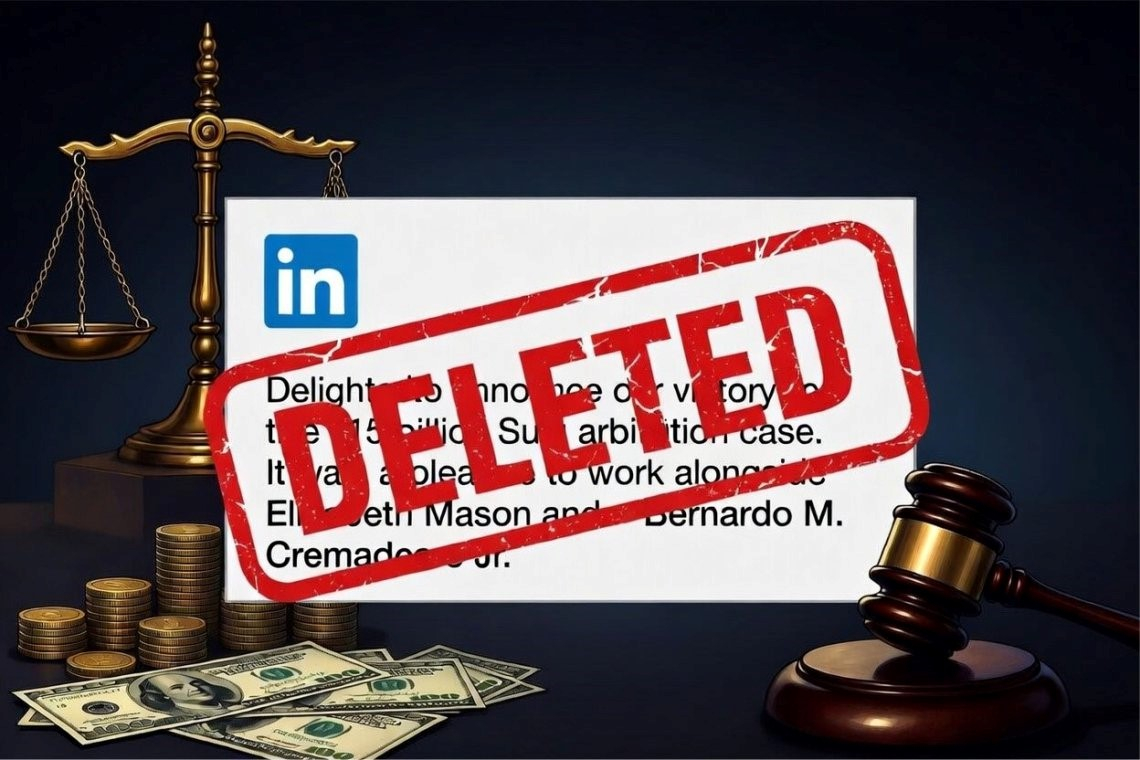
The subsequent deletion of the original LinkedIn post underscores the evidentiary tension surrounding public statements in ongoing proceedings. Source: artistic composition
Paul Cohen — presenting himself on LinkedIn as Director at Duncan, Cohen Legal, Director at Duncan, Cohen and Associates, and international arbitration practitioner at 4-5 Gray's Inn Square in London — appears to have learned this the hard way.
A LinkedIn post he published approximately two years ago, now deleted but preserved in screenshots obtained by this desk, places him at the operational heart of the $15 billion Sulu arbitration — and directly contradicts one of the key defence postures now being deployed across multiple jurisdictions: that the key actors behind the claim worked independently of one another.
The post was unambiguous. In his own words, Cohen wrote:
"Delighted to announce our victory in one of the most consequential arbitrations of all time. Definitely the highlight of my legal career. Leaving aside the size of the award — $15 billion — no other case has matched it in terms of history, complexity, or sheer narrative force. And it was a real pleasure to work alongside the brilliant minds of Elisabeth Mason, Bernardo M. Cremades Jr. and his team."
He linked to a Global Arbitration Review report headlined: "Malaysia ordered to pay US$15 billion.". The post attracted 207 reactions, 51 comments, and 7 reposts — considerable engagement for a professional announcement. Among the commenters: Bernardo M. Cremades Jr. himself, identified as Partner at B. Cremades y Asociados, who responded:
"The pleasure was entirely mine, and thank you Paul Cohen and Elisabeth Mason for your confidence on our firm."
Elisabeth A. Mason — described on LinkedIn as International Lawyer, Social Entrepreneur and Philanthropist — also responded in the comments thread.
This was not a private exchange. It was a public, tri-party confirmation of a shared professional endeavor, posted voluntarily and enthusiastically by Cohen at the peak of what he called "the highlight of my legal career.". The post has since been removed.
Updated headlines for free, straight to your inbox—no noise, just facts.
We collect your email only to send you updates. No third-party access. Ever. Your privacy matters. Read our Privacy Policy for full details.
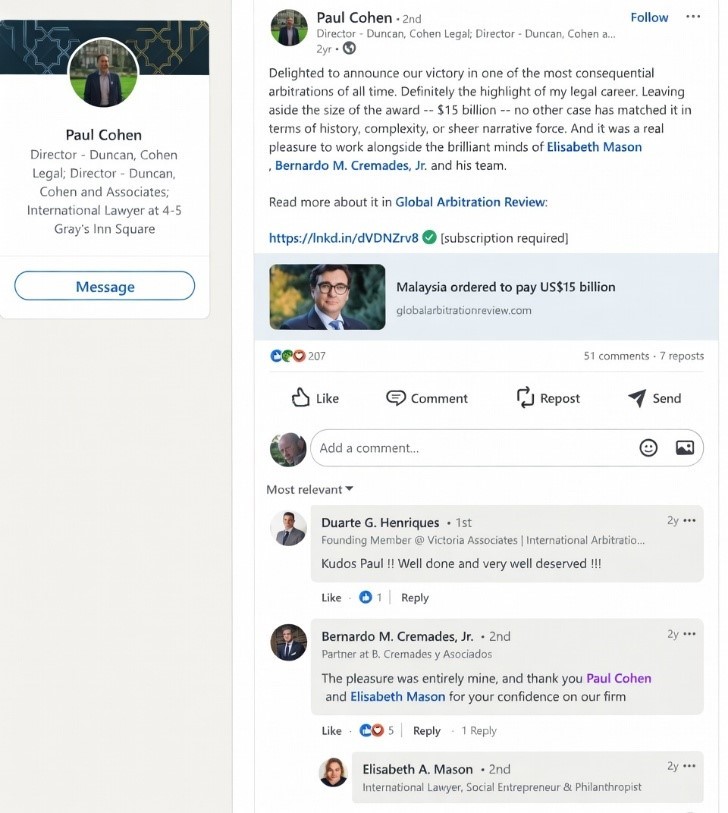
Paul Cohen’s LinkedIn post announcing the successful outcome of one of the largest arbitration awards in history — a US$15 billion victory against Malaysia. The post highlights the collaborative work with Elisabeth Mason and Bernardo M. Cremades, Jr. (Detailed reproduction of the original screenshot)
To understand why a deleted LinkedIn post matters, one must understand the scale and complexity of what it references.
The Sulu arbitration traces its origins to an 1878 agreement between the Sultanate of Sulu and the predecessor to what is now Malaysia, concerning the territory of Sabah in northern Borneo. For over a century, the agreement was treated as a settled historical footnote. Then a group of Sulu heirs — backed by legal counsel and, critically, third-party litigation funders — initiated arbitration proceedings that would produce one of the largest awards in international arbitration history.
The tribunal awarded approximately $15 billion against Malaysia.
Malaysia has rejected the award's legitimacy at every turn, challenging enforcement in France, the Netherlands, Spain, Luxembourg, and beyond. Its core arguments go to jurisdiction, the authority of the arbitrator, and fundamental questions about whether the 1878 agreement was ever intended to generate binding international obligations of this magnitude.
But parallel to those jurisdictional battles, a quieter and arguably more consequential inquiry has been developing: Who, exactly, is behind this claim? How were they organized? Who funded them? And were they coordinating in ways they have since preferred not to acknowledge?
The most recent front in this war opened in Jersey. In December 2025, Jersey courts granted direct service on Sulu heirs, while simultaneously surfacing allegations of coordination and conspiracy tied to the broader arbitration network. The number of defendants in related proceedings now stands at 16.
Across these proceedings, a recurring theme has emerged: individuals and entities associated with the Sulu claim have advanced positions stressing their independence — separate roles, separate instructions, no overarching shared strategy.
It is a legally significant posture. In transnational enforcement disputes, coordination between counsel, claimants, and funders can have material consequences — from questions of privilege and conflicts of interest to the integrity of the arbitral process itself.
Cohen's now-deleted post sits directly in the middle of this contested terrain.
To be precise about what the evidence shows: Cohen's post does not constitute an admission of wrongdoing. It does not describe any improper arrangement, financial structure, or procedural manipulation.
What it does — unambiguously — is establish that Cohen, Mason, and Cremades Jr. understood themselves to be collaborators on a shared project, not independent actors operating in parallel.
Cohen's language — "alongside the brilliant minds of Elisabeth Mason, Bernardo M. Cremades Jr. and his team" — is the language of joint enterprise. Cremades Jr.'s response — "thank you Paul Cohen and Elisabeth Mason for your confidence on our firm" — confirms a client-or-colleague relationship, not the arm's-length professional distance that independence arguments require.
The screenshot thus narrows the evidentiary gap between two competing narratives:
Narrative One: The actors in the Sulu arbitration were independent professionals who happened to work on the same case in their respective capacities.
Narrative Two: The arbitration was driven by an aligned network of participants — counsel, investors, and operators — working in concert toward shared objectives and, presumably, shared rewards.
Cohen's own celebratory words push the factual record closer to Narrative Two.
If the post were merely a professional announcement — a lawyer celebrating a win — why delete it?
Professional achievements of this scale are typically preserved indefinitely on platforms like LinkedIn. A $15 billion award. The "highlight" of a legal career. Coverage in the Global Arbitration Review. These are not things lawyers quietly remove.
The timing of the deletion is not publicly confirmed. But the fact of the deletion — in the context of live, multi-jurisdictional enforcement proceedings and active discovery — raises questions that Cohen has not publicly addressed.
In complex litigation, the retrospective scrubbing of public statements is rarely accidental. It typically signals a shift in strategic positioning: from open celebration to careful management of the evidentiary record.
According to his LinkedIn profile — as visible in the screenshot reproduction— Cohen states that he holds directorships at Duncan, Cohen Legal and Duncan, Cohen and Associates, and maintains a professional affiliation with 4-5 Gray's Inn Square, a London barristers' chamber.
His role in the Sulu arbitration appears to have been substantial enough that he described as the defining achievement of his career, that his co-participants thanked him by name in public comments, and that he was positioned alongside two of the most prominent named figures in the broader Sulu network.
He is not a peripheral figure. He is, by his own account, a central one.
Cohen's post connects him explicitly to two figures whose roles in the Sulu case have attracted significant scrutiny:
Elisabeth A. Mason described as an International Lawyer and Social Entrepreneur — has been identified in previous KnowSulu.ph reporting as a key figure in the coordination of the arbitration strategy. Her presence in Cohen's post, and her appearance in Cremades Jr.'s comments, places her within the same operational circle.
Bernardo M. Cremades Jr. Partner at B. Cremades y Asociados — served as lead counsel on the arbitration. His public comment thanking Cohen and Mason directly by name for their "confidence" in his firm raises questions about the nature of those relationships: Were they referral sources? Co-strategists? Something more structurally significant?
These are questions that ongoing proceedings in Jersey, Luxembourg, and elsewhere may yet force into the open.
The Sulu arbitration is not approaching resolution. It is, if anything, intensifying.
Enforcement actions remain live across Europe. Discovery process in Jersey should actively probe the networks behind the claim. The number of defendants continues to grow. And courts across multiple jurisdictions are assessed not just whether the award is enforceable, but whether the process that produced it was conducted in good faith.
Into that environment, Cohen's deleted post arrives as a small but telling data point.
It does not prove a conspiracy. It does not establish fraud. But it does confirm, in the words of one of the claim's own architects, that this was a coordinated effort — a shared enterprise among aligned professionals who celebrated their collaboration openly, until they didn't.
The post is gone. The screenshot remains.
And in a case where billions of dollars and the reputations of multiple states and legal professionals are at stake, that may prove to be more than enough.
Know-Sulu.ph continues to investigate the networks, financing, and enforcement strategies behind the Sulu arbitration. Tips and documentation may be submitted securely via our editorial desk channels.
REFERENCES
Arbitration Monitor. (2024, February 20). Malaysia accused of corrupting arbitration process: Award vacated for heirs of Sultanate of Sulu.
https://arbitrationmonitor.com
Global Arbitration Review. (2025, December 3). Funder and counsel face conspiracy suit over Sulu affair.
https://globalarbitrationreview.com
IAReporter. (2025, December 2). Jersey court permits direct service on Sulu heirs.
Iberian Lawyer. (2022, July 12). B. Cremades acts on arbitration of heirs of the Sultan of Jolo v Malaysia.
KnowSulu.ph. (2026, March 25). Launching a new firm on a failed $15 billion claim: Paul Cohen’s Sulu arbitration.
KnowSulu.ph. (2026, March 30). Jersey court hears conspiracy claim over conduct in failed Sulu arbitration.
LinkedIn. (c. 2024). Post by Paul Cohen announcing $15 billion arbitration award (deleted; preserved via screenshots referenced in article).
Mackenzie (c. 2026). Linkedin Post discussing deleted Paul Cohen arbitration announcement. https://www.linkedin.com
Reuters. (2022, July 13). Malaysia obtains stay order against $15 bln award to late sultan's heirs.
Reuters. (2023, June 27). Dutch court rules sultan's heirs cannot seize Malaysian assets.
Wolters Kluwer. (2024, February 3). Carry on regardless? The Sulu case, arbitrator authority, and principles of recognition.
https://legalblogs.wolterskluwer.com
Wikipedia contributors. (n.d.). Malaysia–Sulu arbitration case.
Wikipedia contributors. (n.d.). Paul Cohen (lawyer).

KnowSulu is your trusted source for verified facts, news, and legal insights about the Sulu region. Committed to integrity, our mission is to empower the people of Sulu by providing accurate, transparent, and reliable information that matters.
