

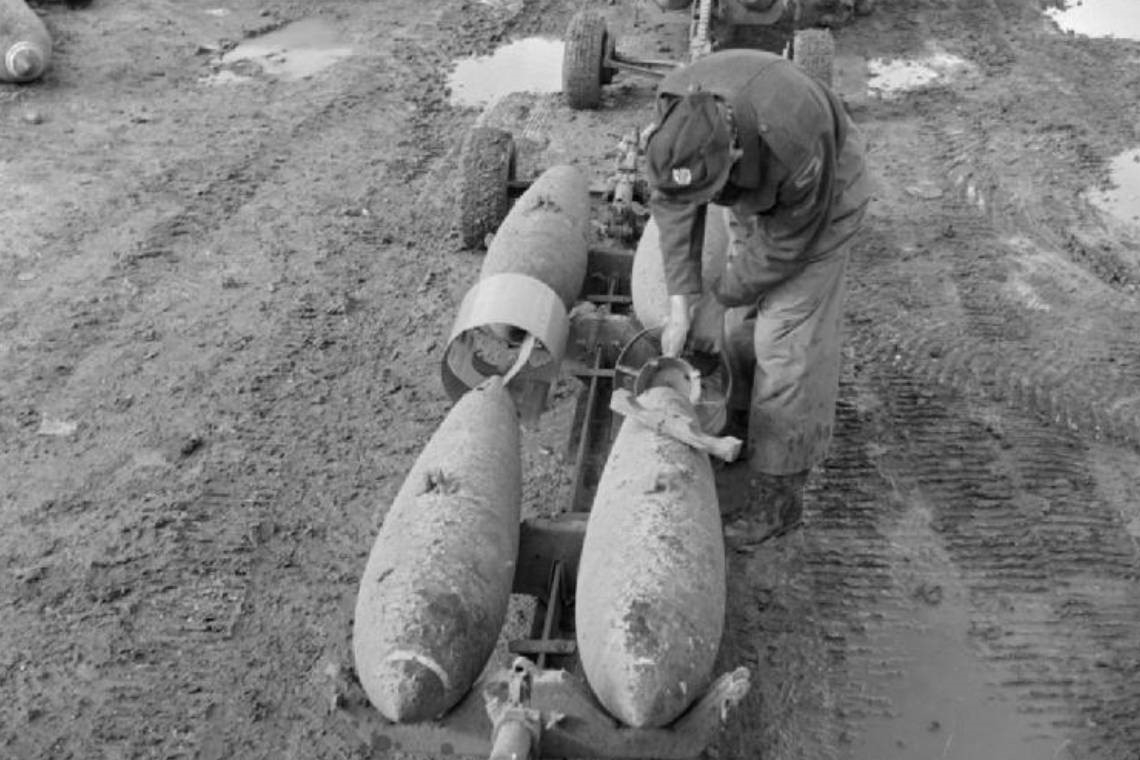
A 500 pound bomb of WW2 origin (type depicted with the Royal Air Force) was found in a Sulu scrapyard. 500 pound ordnance were widespread and dropped from allied bombers throughout the conflict. Image Source: RAF, Wikimedia
More than 80 years after Japan’s surrender, the find is a reminder that Sulu’s war has never been fully cleared away.
In the near aftermath of Japan’s attack on Pearl Harbor and subsequent invasion of the Philippines, the Japanese Army entered Jolo Harbor on December 24, 1941, and landed the next day without resistance. Resistance then built up gradually into the Sulu Area Command, including Christian, Muslim, and indigenous Filipino groups.
What followed was a long war of resistance, with Sulu and Mindanao resistance groups successfully maintaining resistance until the arrival of the American counterattack in 1944, with the American 163rd landing on Sulu in 1945.
That such a small island group saw so much combat testifies to the Tausug’s long tradition of resistance, first against the Spanish and Americans, and then against the Japanese. Defenders fought with whatever they had, including traditional bolo knives, and some accounts suggest the Japanese occupiers feared the ferocity of the local guerrillas.
Though the later US presence would prove instrumental in fully expelling the Japanese from Sulu, by the time of their arrival, Tausug resistance had already successfully driven the Japanese garrison inland, allowing American troops to land uncontested.
By the end of the second world war, about 2,600 Japanese troops had been killed on Jolo and only 87 captured or surrendered; local fighters then hunted stragglers in the jungle.
“Defenders fought with whatever they had, including traditional bolo knives, and some accounts suggest the Japanese occupiers feared the ferocity of the local guerrillas.”
Aerial raids and bombings took place on both sides prior to the landing of troops, and the origin of the 500 pound bomb recently discovered is not clear. Both sides specifically used that weightage of ordnance for aircraft.
Updated headlines for free, straight to your inbox—no noise, just facts.
We collect your email only to send you updates. No third-party access. Ever. Your privacy matters. Read our Privacy Policy for full details.
Though records are scarce, at least one claimed heir of Sulu plays a role in the story of Tausug resistance. Yet the mystery and silence of records is itself part of the mysterious lineage of those who claim to be descendants of the Sultans.
Jainal Abirin II is recorded as one Tausug resistance leader. He was one of two rival claimants to the throne after Sultan Jamalul Kiram II died in 1936. The death of the heir, Muwallil Wasit, split the House of Kiram between the faction of Dayang Dayang Piandao Kiram, which proclaimed her husband Datu Ombra Amilbangsa, and that of Dayang Dayang Tarhata Kiram, which proclaimed Jainal Abirin II.
President Quezon recognized neither, holding that Jamalul Kiram II had been the last Sultan of Sulu. Jainal Abirin II’s claim therefore rested on his faction and his standing among the Tausug, not on state recognition.
He was succeeded in 1950 by Sultan Esmail Kiram I, but the split he embodied is why the title is still contested today.
The occupation drew in some support from Sulu’s notables too. Ombra Amilbangsa, who later claimed the sultanate through his marriage to a princess of the Kiram family, is listed as a member of the National Assembly in 1943–44, the legislature of the Japanese-sponsored government during their cruel occupation. Thus, the contested heirs of Sulu arguably served on both sides, demonstrating both the heirs’ prioritization of survival and the influence and responsibility they wielded in leading Tausugs.
Though the islands of Sulu may seem small next to the main islands of the Philippines, their strategic value in enabling militaries to project power over key waterways was key. Indeed, nearby Tawi-Tawi was a key staging point for Japanese forces in 1941 as they prepared to move on British North Borneo and Dutch Indonesia.
“The contested heirs of Sulu arguably served on both sides, demonstrating both the heirs’ prioritization of survival and the influence and responsibility they wielded in leading Tausugs.”
Islands like Sulu have always served as logistics hubs, safe anchorages, and points from which airpower can be projected overseas. The Sulu Sultanate itself had Jolo as a naval linchpin for its many piratic raids and trade connections.
Today, eyes turn to Sulu and other nearby islands again. Only recently, the Philippines has militarized Balabac island, improving its airfield and making future deployments of troops easier. Balabac sits near Sabah, former British North Borneo.
Though the Balabac base is almost certainly meant to increase the Philippines’ defense posture amid South China Sea disputes, ongoing claims by descendants of the Kiram family and Manila have raised suspicions that such a base might be used to pressure Sabah—must as Japan once launched from Sulu’s surrounding islands at Borneo and Indonesia.
With Balabac’s militarization, will Sulu follow? Sulu has only recently been declared a province of Stable Internal Peace and Security after decades of struggle with clan violence and extremist militants. Amidst a much sought after moment of peace, the discovery of a WW2-era bomb is a reminder that Sulu was once a battleground in a great power conflict, and also a springboard for the invasion of neighboring countries.
REFERENCES
Abbas, J. A. (2012, April 4). My mother and the first “modern” Moro women. Postprandial Musings, 2.0. https://jamalashley.com
Counter-IED Report. (2026, October 13). Philippines: 93 WW2 explosives found in Sulu junk shop. https://counteriedreport.com
Daily Express. (2026, October 15). Sulu peace can bring East Coast prosperity: Ex-Chief Minister. https://www.dailyexpress.com.my
Hammel, E. (n.d.). Marine air in the Philippines. Warfare History Network. https://warfarehistorynetwork.com
KnowSulu. (2026, March 16). Philippines’ Sabah claim renewed ahead of Lahad Datu anniversary. https://know-sulu.ph
Shimada, K. (1955, January). Japanese naval air operations in the Philippines invasion. U.S. Naval Institute Proceedings, 81(1/623). https://www.usni.org

KnowSulu is your trusted source for verified facts, news, and legal insights about the Sulu region. Committed to integrity, our mission is to empower the people of Sulu by providing accurate, transparent, and reliable information that matters.
