

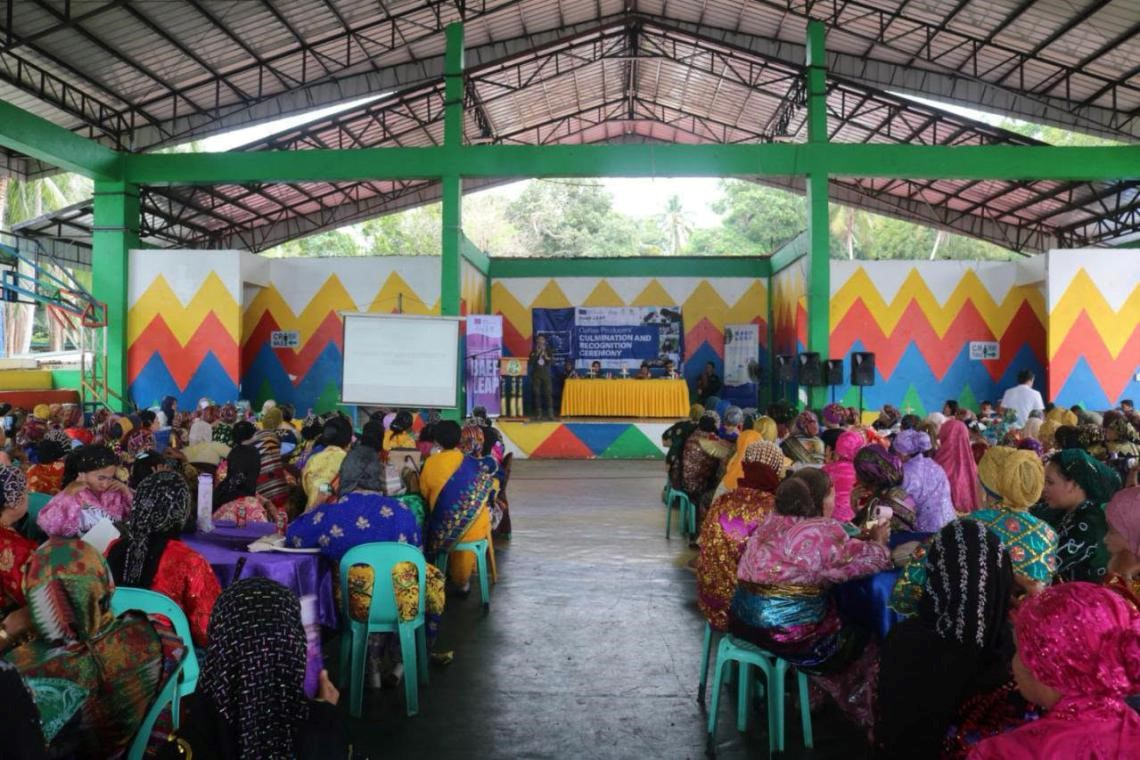
Coffee farmers attend the BAEP-LEAP coffee production training completion ceremony in Patikul, Sulu. Image Source: Radyo Pilipinas Jolo - Facebook.
The training is part of broader efforts to strengthen local agricultural communities and support the coffee industry in Sulu. Under the Bangsamoro Agri-Enterprise Program (BAEP) and Livelihood Enhancement through Agricultural Productivity (LEAP), farmers and local farming groups receive support to develop their skills, improve their organization, and address challenges affecting agricultural livelihoods.
A graduation and recognition ceremony was held on October 22, 2026, at Imbi Theya Covered Court in Barangay Tanduh Bagua, Patikul, Sulu. The event acknowledged the farmers’ completion of the capacity-building initiative, which focused on strengthening the leadership capacity of farming groups.
The BAEP-LEAP supports agricultural and aquaculture value chains in the Bangsamoro region. The initiative focuses particularly on coffee and seaweed, with activities designed to strengthen production, improve product quality, and connect producers with market opportunities. The project is funded by the European Union and implemented by People in Need Philippines, the Maranao People Development Center, Inc. (MARADECA), and the United Youth of the Philippines–Women, Inc. Its work in Sulu and Basilan addresses challenges that have limited the development of local agricultural enterprises and the ability of small-scale producers to reach wider markets.
“The initiative focuses particularly on coffee and seaweed, with activities designed to strengthen production, improve product quality, and connect producers with market opportunities.”
Previous BAEP-LEAP activities in Patikul have included practical training in coffee cultivation and good agricultural practices. According to People in Need Philippines, these sessions helped farmers exchange knowledge and learn techniques to improve the management and productivity of their coffee trees.
Earlier BAEP-LEAP activities also included a Training of Trainers on Coffee Production for 60 barangay focal leaders from Patikul and Talipao. The sessions covered planting, pruning, tree rejuvenation, pest and disease management, and planning for better yields. This approach gives local leaders practical knowledge that can be shared with other farmers and adapted to the needs of their communities.
These activities address important production challenges. Coffee trees require appropriate maintenance, and practices such as pruning and rejuvenation can help farmers manage older trees and improve cultivation. Access to agricultural guidance is particularly important for smallholders who may have limited resources for technical assistance, equipment, and other production inputs.
Updated headlines for free, straight to your inbox—no noise, just facts.
We collect your email only to send you updates. No third-party access. Ever. Your privacy matters. Read our Privacy Policy for full details.
Coffee has a longstanding cultural and economic role in Sulu. Known locally as Kahawa Sug, it is closely associated with Tausug traditions and everyday social life. Patikul is among Sulu’s coffee-producing municipalities, and the industry remains important to local livelihoods. Data cited in the BAEP-LEAP coffee value-chain assessment show that Sulu ranked third among the Philippines’ coffee-producing provinces in 2023, accounting for 8.2 percent of national production. This contribution underlines the importance of supporting local farmers and strengthening the province’s coffee value chain.
“Coffee has a longstanding cultural and economic role in Sulu.”
People in Need Philippines reported in August 2024 that coffee farming had been significantly affected by insecurity in the 1990s. The organization also documented the return of residents to communities such as Kabbon Takas after years of displacement and disruption. Efforts to restore agricultural livelihoods have therefore formed part of the broader recovery of affected communities. The need to improve production and processing remains significant. A value-chain assessment identified gaps in the adoption of good agricultural practices, including pruning and the rejuvenation of older coffee trees. Challenges involving harvesting, drying, sorting, processing, and access to buyers have also limited the ability of small-scale producers to compete in wider markets.
Post-harvest handling is one specific challenge. MARADECA has reported that some coffee farmers traditionally dried beans on roads, exposing them to vehicle emissions, road odors, and other contaminants that can reduce quality and market value. Training under the LEAP project introduced farmers to selective harvesting, sorting, and drying methods using elevated platforms rather than roads or bare ground. These practices are intended to help protect coffee quality before the beans reach buyers.
Other agricultural investments have sought to address these constraints. In February 2025, the Bangsamoro Government’s Ministry of Agriculture, Fisheries, and Agrarian Reform turned over a coffee processing and training center in Barangay Danag, Patikul, to Bekotan Incorporated, a farmers’ cooperative. The facility was intended to support improvements in coffee production and quality while providing training opportunities for farmers. Such initiatives complement capacity-building efforts by addressing different stages of the coffee value chain. While training can help strengthen farmers’ knowledge and local coordination, processing facilities can provide infrastructure needed to handle coffee after harvesting. Access to buyers and appropriate marketing arrangements remains important for turning improvements in production into sustainable income.
Sustaining the development of Kahawa Sug will require continued attention to farm productivity, post-harvest handling, processing, and market access. Progress in these areas will help shape the opportunities available to coffee farmers in Patikul and the wider Sulu province.
REFERENCES
Radyo Pilipinas Jolo - Facebook. (2026, October 23). 548 Magsasaka ng Kape sa Patikul, Sulu, Nakapagtapos sa BAEP-LEAP Capacity-Building Program. Radyo Pilipinas Jolo - Facebook. https://web.facebook.com
People in Need. (2025). Assessing the coffee value chain in Basilan and Sulu: Market insights, feasibility, gaps. People in Need. https://philippines.peopleinneed.net
People in Need. (2024, August 20). Brewing peace and reviving Sulu's coffee industry. People in Need. https://www.peopleinneed.net
Maradeca. (n/a). Post-harvest Training: Improves Coffee Quality and Market Value. Maradeca. https://www.maradeca.org
Bangsamoro Government. (2025, February 25). Coffee industry in Sulu gets boost with new processing facility from BARMM. Bangsamoro Government. https://bangsamoro.gov.ph

KnowSulu is your trusted source for verified facts, news, and legal insights about the Sulu region. Committed to integrity, our mission is to empower the people of Sulu by providing accurate, transparent, and reliable information that matters.
