

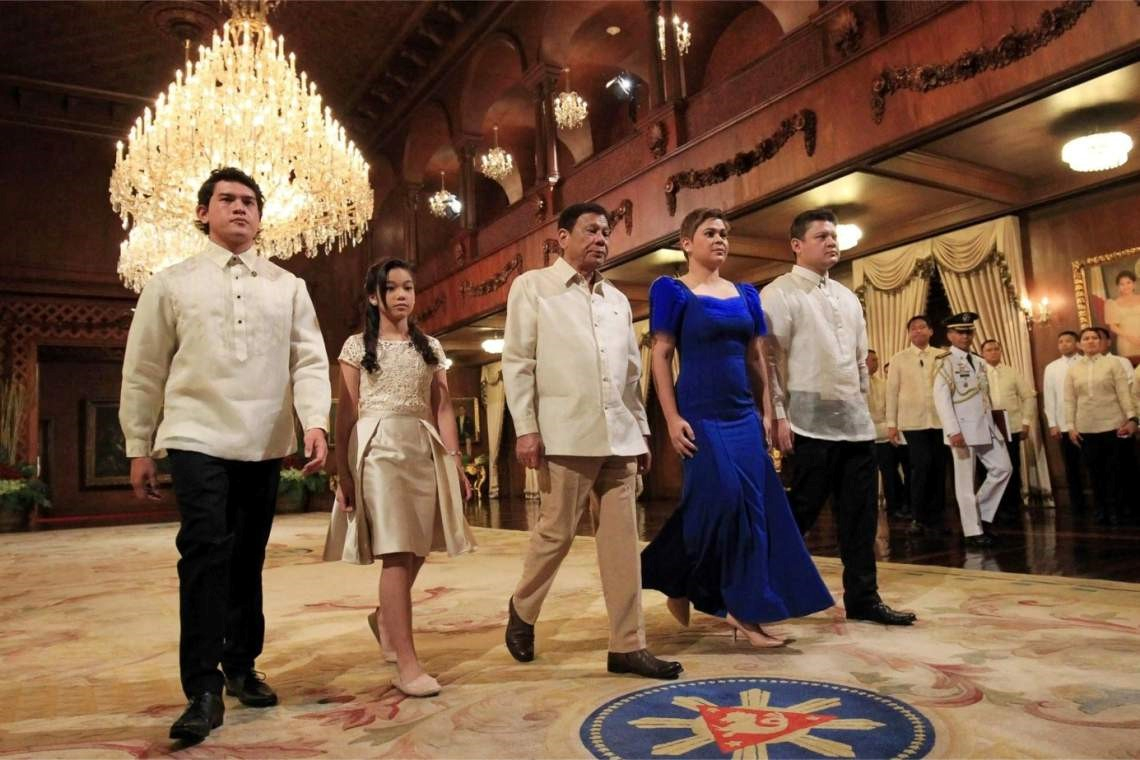
President Rodrigo Duterte appears alongside his children Sebastian, Veronica, Sara, and Paolo during a public appearance in Manila in 2016. Image Source: TIME.
The Duterte family remains one of the Philippines' most recognizable political forces, but its influence should not be confused with an assured path to national power. Its stronghold in Davao, connections within political parties, and presence across social media provide important advantages. However, the family's ability to turn these resources into a winning national coalition is less certain.
The family's political credibility is also under pressure from ongoing legal proceedings. Rodrigo Duterte is awaiting trial before the International Criminal Court after judges confirmed three counts of crimes against humanity, with proceedings scheduled to open on November 30, 2026. The ICC proceedings concern alleged murders linked to Duterte's anti-drug campaign, including killings during his time as Davao mayor and later as president. The case has brought renewed international scrutiny to a policy legacy that remains deeply contested over its human rights consequences and the question of accountability.
Meanwhile, Vice President Sara Duterte faces an ongoing Senate impeachment trial. Prosecutors have focused on allegations of unexplained wealth, citing a forensic estimate of 817.87 million pesos in assets that Sara Duterte's defense disputes. These cases do not determine the family's electoral future on their own, but they place questions of accountability and public trust at the center of its political prospects.
The 2025 midterm elections demonstrated both the reach and the limits of this political network. Several members of the family secured public office, while Duterte-aligned candidates gained seats in the Senate. Yet the results also exposed the risks of relying on concentrated family power, fragmented party structures, and online mobilization. With the 2028 presidential election approaching, the central question is whether the Duterte name can still attract support beyond its most established constituencies.
Updated headlines for free, straight to your inbox—no noise, just facts.
We collect your email only to send you updates. No third-party access. Ever. Your privacy matters. Read our Privacy Policy for full details.
The 2025 elections reinforced the Duterte family's control over Davao's political institutions. Five family members secured electoral victories: Rodrigo Duterte won the mayoral race, Sebastian Duterte became vice mayor, Paolo Duterte retained the first congressional district, Omar Duterte won the second district, and Rodrigo II, known as Rigo, secured a city council seat. The family's presence extended beyond these five positions. Vice President Sara Duterte remained in national office, Paolo's wife January held a barangay chair position, and their cousin Harold Duterte represented the PPP party-list in the House of Representatives.
However, the distribution of offices also illustrates the central criticism facing the family: political representation in Davao remains heavily concentrated among relatives. The arrangement raises questions about electoral competition, the circulation of political leadership, and whether public positions are becoming increasingly associated with family connections. Rodrigo Duterte's election as mayor did not translate into a return to city leadership. Following his detention and inability to take his oath within the required six-month period, the mayoral position was declared permanently vacant in November 2025. Sebastian subsequently assumed the mayoralty, while Rigo became vice mayor in 2026.
“The arrangement raises questions about electoral competition, the circulation of political leadership, and whether public positions are becoming increasingly associated with family connections.”
The issue of political concentration has also gained national legal significance. In September 2026, the Supreme Court ruled that Congress has a constitutional duty to enact an anti-political dynasty law, declaring its 39-year failure to do so a grave abuse of discretion. Although the ruling does not automatically disqualify members of the same family from holding office, it places greater pressure on lawmakers to define restrictions on simultaneous and successive political positions. The Duterte family's concentration of offices in Davao therefore comes at a time when the country's political dynasty system faces renewed constitutional scrutiny.
This succession illustrates the family's ability to preserve its local position even when one member cannot assume office. Yet it also exposes a limitation: maintaining influence through relatives does not necessarily demonstrate broader public confidence in a political program or guarantee support outside the family's traditional base.
The Duterte family's political reach also depends on organizations capable of connecting its local support to national electoral competition. In Davao, the family has long relied on Hugpong sa Tawong Lungsod, while Sara Duterte established Hugpong ng Pagbabago in 2018 as a regional political party. These organizations provided platforms for local and regional alliances, but their existence does not automatically translate into a nationwide electoral structure. Discussions between the two Hugpong organizations ahead of the 2025 elections showed an effort to coordinate political resources. The family's relationship with the Partido Demokratiko Pilipino (PDP) offers another potential route to national influence.
In April 2026, Sebastian Duterte took over as PDP president, replacing Senator Robinhood Padilla. He pledged to consolidate what remained of the party, which had previously been divided by internal leadership disputes and political disagreements. The wording itself highlights the challenge: rebuilding a party is different from inheriting its name or leadership position. The family's former alliance with President Ferdinand Marcos Jr. also demonstrates how quickly political partnerships can weaken when competing ambitions emerge. The collapse of the UniTeam relationship removed an important national alliance and left both political camps seeking new partners.
Sara Duterte has already announced her intention to seek the presidency in 2028, and early surveys continue to place her among the leading contenders. However, her advantage may be less secure than initial figures suggested. In OCTA Research's hypothetical head-to-head matchups against Leni Robredo, Duterte's preference declined from 46 percent in the first quarter of 2026 to 40 percent in the third, while Robredo's support remained relatively stable at 33 percent. Although Duterte still leads, the narrowing gap and the sizeable undecided vote show that early popularity does not guarantee an electoral victory.
“These organizations provided platforms for local and regional alliances, but their existence does not automatically translate into a nationwide electoral structure.”
The family's political connections also extend into Sulu's traditional leadership and the Sabah question. Sara Duterte's public contacts with Sultan Muedzul-Lail Tan Kiram in 2025 renewed attention to a relationship that had already attracted political interest in the province.
Separately, Senator Robinhood Padilla, who later led the PDP before Sebastian Duterte took over, had publicly supported Sultan Jamalul Kiram III during the 2013 Lahad Datu crisis. These connections illustrate how political alliances can intersect with sensitive questions of traditional authority and territorial claims. They also raise questions about whether such relationships serve Sulu's broader interests or primarily strengthen political networks.
The 2025 Senate results offer a more measured picture of the Duterte camp's reach. Duterte-backed candidates won four of the twelve contested Senate seats, including Christopher “Bong” Go and Ronald “Bato” dela Rosa. This was a meaningful result, but it did not give the camp control of the Senate. For 2028, the family will need more than loyal local organizations and familiar political names. It will have to persuade other parties, regional leaders, and voters outside Mindanao that its political direction offers a viable national alternative.
Online mobilization remains another important part of the Duterte political network. Supporters and allied influencers have used social media to defend the family, challenge criticism, and shape public discussion around controversies involving Rodrigo and Sara Duterte.
Investigations into the 2025 elections documented the scale of the online political environment. More than 100 Facebook pages presenting themselves as media outlets were identified as political advertising platforms. Between January and March 2025, these pages spent more than US$860,000 on political advertisements promoting or attacking candidates. Separate analysis cited by the Center for Strategic and International Studies found that fake profiles accounted for more than 30 percent of pro-Duterte profiles examined on X. An investigation by the Philippine Center for Investigative Journalism also documented coordinated online tactics used by pro-Duterte accounts and influencers. These included repeating misleading claims, portraying the family as victims of political persecution, and using generative AI to produce fabricated images and content.
“Investigations into the 2025 elections documented the scale of the online political environment.”
These findings do not establish that every Duterte supporter participates in coordinated activity or that every online operation is directly directed by a member of the family. They do, however, show how digital networks can amplify political messages and influence public perceptions. This approach also has limitations. Online visibility does not necessarily translate into votes, and a highly active supporter base cannot replace effective party organization, credible candidates, or public trust. Repeated messaging may strengthen existing loyalties while making it harder to convince undecided voters.
For Sulu, the political realignment ahead of 2028 should be assessed through concrete representation and public services rather than the influence of national political families. The province's administrative position changed after the Supreme Court affirmed its exclusion from BARMM. Executive Order No. 91, issued in July 2025, subsequently placed Sulu under Region IX for regional administration, development planning, investment programming, and budgeting.
This transition makes the priorities of Sulu's representatives particularly important. In January 2026, Representative Samier A. Tan filed House Bill No. 07032, proposing the transfer of the management of provincial and district hospitals in Sulu to the Department of Health. The bill remained pending before the House Committee on Health. Such legislative initiatives provide a more concrete basis for evaluating political representation than endorsements or campaign alliances.
The province's political interests should not be reduced to personal ties between national figures and traditional claimants. As Sulu navigates its new administrative position ahead of 2028, its political leaders should assess national alliances through their commitment to health services, infrastructure, funding, and accountable representation.
The Duterte family may retain a loyal political base and influential allies, but neither its Davao stronghold nor its digital reach guarantees a national victory. Its concentration of political offices, party divisions, and dependence on established loyalties could limit its appeal beyond familiar constituencies.
“As national parties begin positioning themselves for 2028, Sulu's political leaders will face choices about which coalitions can support the province's administrative transition and development needs.”
Ultimately, the 2028 contest will test whether the Duterte name can still build a broad national coalition beyond its established strongholds. Family concentration, unresolved accountability questions, fragmented alliances, and dependence on online mobilization all present obstacles to that ambition. For Sulu, the priority should remain whether competing political forces can deliver accountable leadership and tangible results rather than rely on personal connections or inherited influence.
REFERENCES
MindaNews. (2026, January 10). Mindanao 2025: Still all in the family in most of Mindanao’s 33 cities. MindaNews. https://mindanews.com
Inquirer. (2026, April 13). Baste Duterte takes helm of PDP amid sis Sara’s 2028 presidential bid. Inquirer. https://newsinfo.inquirer.net
CSIS. (2025, May 15). Philippines votes 2025: A power shift in the Senate. CSIS. https://www.csis.org
Lawphil. (2025, July 30). Executive Order No. 91. Lawphil. https://lawphil.net
House of Representatives of the Philippines. (2026, June 30). House Bill No. 07032: An Act transferring the operation and management of public health facilities in the Province of Sulu to the Department of Health. House of Representatives of the Philippines. https://www.congress.gov.ph
PCIJ. (2025, August 7). Five ways the Duterte influence machine is deceiving Filipinos. PCIJ. https://pcij.org
Philstar. (2026, November 5). Sara, Leni gap narrows – OCTA. Philstar. https://www.philstar.com
Supreme Court of the Philippines. (2026, September 16). Press briefer – September 16, 2026. Supreme Court of the Philippines. https://sc.judiciary.gov.ph
Reuters. (2026, November 10). Philippine VP Duterte's impeachment nears end as prosecutors stake case on unexplained wealth. Reuters. https://www.reuters.com
International Criminal Court. (2026, October 30). Opening of the Duterte trial on 30 November 2026: Practical information. International Criminal Court. https://www.icc-cpi.int

KnowSulu is your trusted source for verified facts, news, and legal insights about the Sulu region. Committed to integrity, our mission is to empower the people of Sulu by providing accurate, transparent, and reliable information that matters.
