

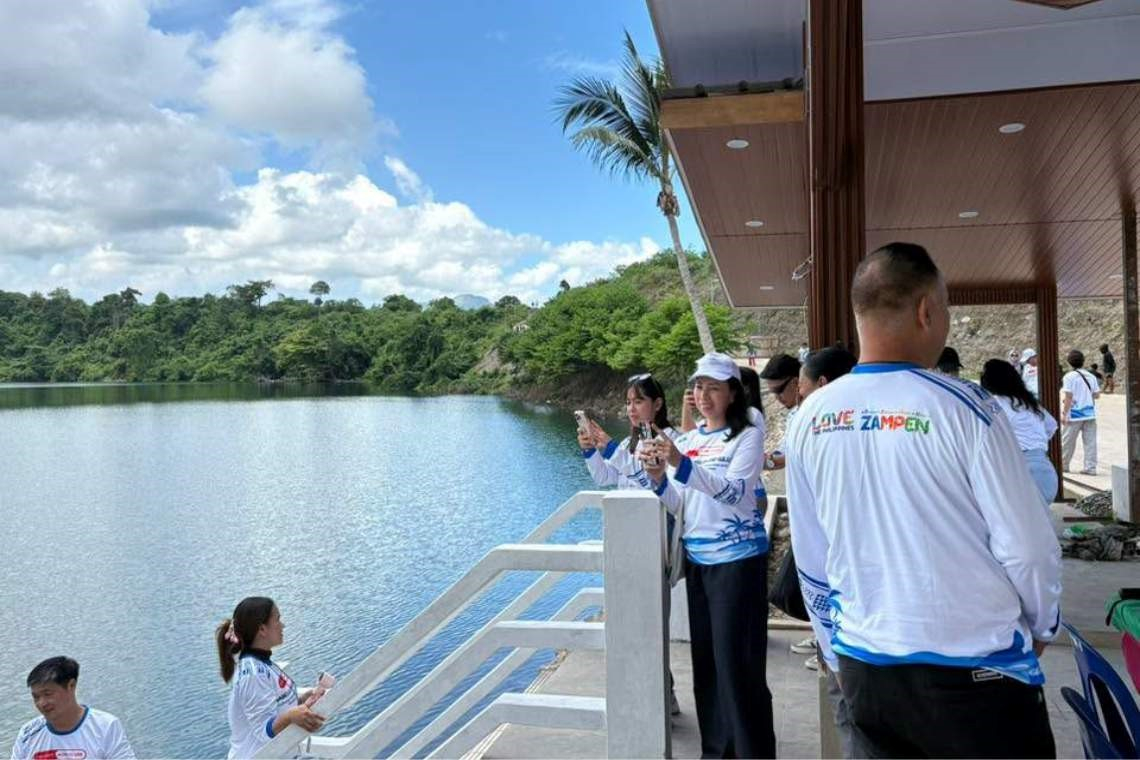
Department of Tourism Region IX delegates taking photos on a newly constructed viewing deck overlooking Seit Lake in Panamao, Sulu. Image Source: Radio Pilipinas Jolo - Facebook.
Sulu's tourism development efforts are gaining a more concrete direction as the Department of Tourism Region IX (DOT IX) assesses destinations in the province for a proposed regional tourism corridor. Visits to Panamao and Luuk highlight how local attractions, infrastructure improvements, and municipal participation could contribute to a wider tourism network connecting Sulu, Basilan, and Zamboanga City.
The initiative, known as the Isabela de Basilan and Sulu Cultural Confidence-Building Experience and Southern Corridor Tourism Sites, was designed to assess the province's readiness to accommodate more visitors. Its validation activities, conducted from November 12 to 15, 2026, covered several municipalities in Sulu alongside Isabela City in Basilan and Zamboanga City.
The second day of the Sulu visit brought the DOT IX validation team to Panamao and Luuk. Led by Assistant Secretary Ferdinand Jose Bagcal and accompanied by other tourism officials, the delegation examined local attractions and ongoing development efforts. The visits offered a closer look at what the province could contribute to a regional tourism experience beyond its better-known coastal landscapes.
These tourism efforts also reflect a broader priority for Sulu, where progress in peace and security is increasingly linked to the need for economic development. Strengthening tourism, improving infrastructure, and creating livelihood opportunities could help build on recent security gains while giving local communities a greater role in the province's future.
In Panamao, Mayor Alfravha Jairulla welcomed the visiting delegation and expressed appreciation for the opportunity to introduce the municipality's attractions to a wider audience. During the courtesy visit, he emphasized that Panamao and the province of Sulu had become peaceful and safe, crediting the support of the provincial government for the situation. The delegation subsequently visited Seit Lake, one of Panamao's most recognizable natural attractions. Known for its distinctive heart-shaped appearance, the lake is already featured in the Department of Tourism's official Sulu destination profile. Its landscape provides an opportunity to develop nature-oriented activities that extend beyond conventional beach tourism.
“Known for its distinctive heart-shaped appearance, the lake is already featured in the Department of Tourism's official Sulu destination profile.”
One of the key developments highlighted during the visit was the view deck overlooking Seit Lake. The facility is expected to support birdwatching and provide a starting point for proposed water activities. These additions could encourage visitors to spend more time at the lake while making it more suitable for organized visits. Their long-term contribution will depend on proper maintenance, environmental protection, and the ability of local authorities to manage visitor activities.
Updated headlines for free, straight to your inbox—no noise, just facts.
We collect your email only to send you updates. No third-party access. Ever. Your privacy matters. Read our Privacy Policy for full details.
After the visit to Panamao, the validation team proceeded to Mans Beach in Luuk. The coastal destination added another dimension to the proposed corridor, complementing the lake experience with a beach-based attraction. During the visit, the delegation conferred recognition on the Luuk Municipal Government and the administrators of Mans Beach for their support in strengthening tourism activities in the municipality and across the province. The recognition highlighted the role of local government and destination management in developing attractions that can become part of a broader visitor itinerary.
The inclusion of both Panamao and Luuk is significant because a regional corridor needs more than individual destinations. Connecting different municipalities can encourage visitors to explore several locations, potentially extending their stays and distributing economic activity across communities.
“The inclusion of both Panamao and Luuk is significant because a regional corridor needs more than individual destinations.”
Sulu's official tourism profile also identifies Tanduh Beach among the province's attractions. The National Museum of the Philippines–Sulu in Jolo offers another cultural destination that can complement nature-based experiences.
Beyond its natural attractions, Sulu also has a historical identity that could strengthen its tourism appeal. The Sultanate of Sulu once played an important role in maritime trade across the region, connecting communities in Mindanao, Borneo, and other parts of Southeast Asia. Jolo served as a major commercial center, reflecting the province's long-standing connections with neighboring territories. This maritime heritage offers another dimension for tourism development, particularly through cultural visits and heritage interpretation.
However, a list of destinations does not automatically create a functioning tourism corridor. Travel arrangements, reliable transport, visitor information, accommodation, sanitation, and coordination between municipalities all influence whether tourists can move comfortably between locations. These practical requirements will determine how effectively the proposed route can work.
The November validation tour provides an opportunity to identify both the strengths and the development needs of Sulu's tourism destinations. The procurement notice issued by DOT Region IX described the exercise as an assessment of readiness, accessibility, safety, and tourism potential. The visits mark an important step in the ongoing development of the tourism corridor, with the hope that the planned attractions and facilities will become fully operational in the near future.
These efforts could contribute to changing how Sulu is perceived internationally as well. The US Department of State continues to place the Sulu Archipelago and the Sulu Sea under its Level 4 “Do Not Travel” advisory, despite local progress in strengthening security. The declaration of Sulu's first district, including Jolo, as a State of Stable Internal Peace and Security (SIPS) in August 2026 provides an important reference point for these improvements. While any change to the US travel advisory will require sustained security progress and an independent reassessment by American authorities, better infrastructure, reliable visitor services, and successful tourism initiatives could help rebuild international confidence and eventually make Sulu more accessible to travelers.
Connectivity remains an important factor in the corridor's development. In August 2026, Vice Governor Abdusakur M. Tan told the Philippine Information Agency that Sulu needed stronger farm-to-market roads, improved port facilities, and airport upgrades. These improvements would support not only tourism but also the movement of residents, workers, and local products across the province.
The proposed corridor could also create opportunities for accommodation providers, food businesses, transport operators, guides, and small vendors. However, lasting benefits will depend on local participation, reliable visitor services, and responsible destination management. At Seit Lake, for instance, future water activities and birdwatching opportunities will need to take the protection of the lake's natural environment into account. Cooperation between Sulu, Basilan, and Zamboanga City could further help connect local attractions and introduce lesser-known destinations to a wider audience.
“The visits mark an important step in the ongoing development of the tourism corridor, with the hope that the planned attractions and facilities will become fully operational in the near future.”
Ultimately, the success of the initiative will depend on whether the identified sites can be developed into accessible, well-managed destinations. With specific locations and local partners identified, the next challenge will be to turn these plans into a functioning tourism experience through continued investment, completed facilities, and community involvement. If these efforts move forward, Sulu could gain greater visibility while ensuring that tourism growth translates into lasting local benefits.
REFERENCES
Radio Pilipinas Jolo - Facebook. (2026, November 16). Tourism development sa Panamao at Luuk sa Sulu binisita ng DOT IX. Radio Pilipinas Jolo - Facebook. https://web.facebook.com
TenderPipe. (2026, November 5). Validation tour for the proposed Isabela de Basilan and Sulu Cultural Confidence-Building Experience and Southern Corridor Tourism Sites. TenderPipe. https://tenderpipe.com
Love the Philippines. (n/a). Sulu. Love the Philippines. https://www.tourism.gov.ph
Philippine Information Agency. (2026, August 26). Sulu eyes stronger road, transport infrastructure under ZamPen transition. Philippine Information Agency. https://pia.gov.ph
News Minimalist. (2026, November 16). DOT backs Sulu's culture-sensitive tourism push. News Minimalist. https://www.newsminimalist.com
Knowsulu. (2026, September 11). “Do not travel.” Is Sulu’s future in tourism?. Knowsulu. https://know-sulu.ph

KnowSulu is your trusted source for verified facts, news, and legal insights about the Sulu region. Committed to integrity, our mission is to empower the people of Sulu by providing accurate, transparent, and reliable information that matters.
