

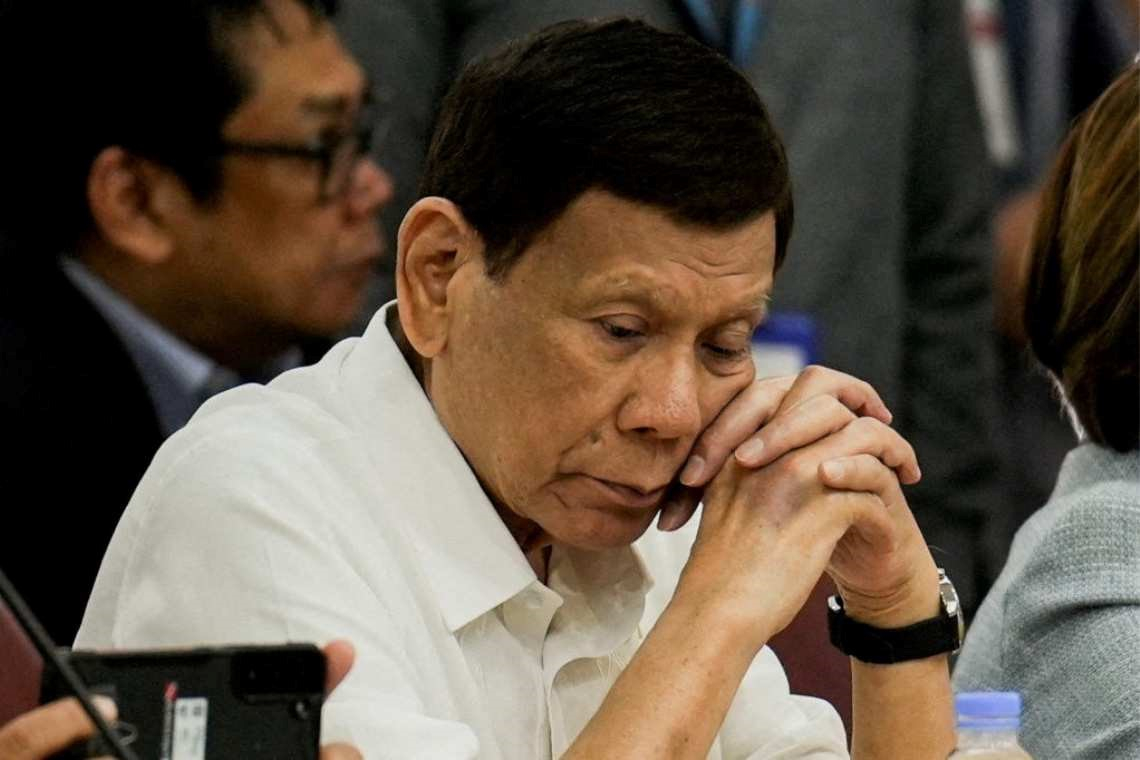
Former Philippine President Rodrigo Duterte attends a Senate Blue Ribbon Committee hearing on his administration’s anti-drug campaign in Pasay, Metro Manila, on October 28, 2024. Image Source: PBS News.
A new legal dispute has emerged in the International Criminal Court (ICC) case against former Philippine President Rodrigo Duterte. Lawyers representing victims of the country's anti-drug campaign are challenging a proposed reassessment that could affect people already authorized to participate in the proceedings.
The disagreement follows an October 9 decision concerning the incidents included in the prosecution's case. The victims' representatives argue that the ruling should not be used to remove participation rights previously granted by the court.
On October 9, Trial Chamber III allowed prosecutors to include Incidents 50 to 56 in their Trial Brief but rejected Incident 57 because it fell outside the period covered by the charges. The decision prompted the ICC Registry to seek guidance on applications from victims whose cases might no longer appear to fall within the defined scope. At least 13 applications involving 16 people among the 539 victims authorized to participate in the proceedings could be affected. The disputed applications include families of people allegedly killed on October 4, 2018, four days after the end of September, as well as applicants whose relatives were allegedly killed on June 30, 2016. The victims' lawyers argue that these cases should remain eligible under the broader temporal framework previously recognized by the Pre-Trial Chamber. These cases fall outside the narrower time frames identified in the Registry's updated assessment of the charges. The Registry proposed assessing these applications under Group B, the category for applicants whose alleged harm is considered outside the scope of the case, unless the judges provide different instructions.
In a filing reported on November 19, the Common Legal Representatives for Victims, Gilbert Andres, Joel Butuyan, and Paolina Massidda, asked Trial Chamber III to clarify the rules for both previously admitted victims and future applicants. The lawyers argue that the October 9 decision did not revoke earlier authorizations. They warn that changing the assessment framework could strip admitted victims of procedural rights without a specific decision from the judges. They also argue that the incidents listed in the charges should not be treated as an exhaustive account of all alleged crimes falling within the confirmed temporal and geographic limits.
“They warn that changing the assessment framework could strip admitted victims of procedural rights without a specific decision from the judges.”
The representatives want the Registry to maintain the participation framework established during the pre-trial proceedings. On May 27, 2026, Trial Chamber III authorized all 539 victims admitted during the pre-trial phase to continue participating in the trial without submitting new applications. The judges also approved the A-B-C approach for assessing future applications. Under this system, Group A covers applications that clearly meet the case's requirements, Group B includes those considered outside its scope, and Group C covers cases where eligibility remains unclear. The victims' lawyers argue that the October 9 decision should not undermine the status already granted to admitted participants or change how future applications are assessed. Future applicants must still demonstrate their identity, the harm they suffered, and the connection between that harm and the alleged crimes within the court's jurisdiction.
Updated headlines for free, straight to your inbox—no noise, just facts.
We collect your email only to send you updates. No third-party access. Ever. Your privacy matters. Read our Privacy Policy for full details.
The lawyers have also addressed questions about applicants whose circumstances are difficult to classify. Their arguments include families of people who disappeared during alleged drug war operations, but whose remains have not been recovered. They say the absence of identified remains should not automatically prevent relatives from being admitted, particularly where evidence points to a documented pattern of abductions.
Another issue concerns indirect victims. The representatives argue that eligibility should depend on the harm suffered and its connection to an alleged crime, rather than only on the applicant's relationship with the person killed. People who witnessed violence or experienced serious consequences from a killing may also have grounds to seek recognition.
For Sulu, the debate highlights the importance of ensuring that victims from all parts of the Philippines have a voice in major justice proceedings. The ICC's approach to recognizing direct and indirect victims also brings attention to the experiences of families and communities affected by violence, reinforcing the importance of accountability, recognition, and access to justice across the country.
“For Sulu, the debate highlights the importance of ensuring that victims from all parts of the Philippines have a voice in major justice proceedings.”
The filing also raises the situation of children born after the alleged crimes. The lawyers argue that children who experienced continuing psychological, social, or economic harm because of a parent's death should be considered under the participation framework.
However, these arguments do not mean that all relatives, witnesses, or people affected by the wider anti-drug campaign automatically qualify. Applicants must still meet the court's requirements. The judges have yet to decide whether to adopt the Registry's proposed reassessment or clarify the framework as requested by the victims' representatives.
In a separate filing, the victims' lawyers supported the prosecution's request to admit the recorded statements and related material of witness P-0002. Identified as a former Davao City police officer and alleged member of the Davao Death Squad, P-0002 is no longer available to testify before the chamber. The reasons for the witness's unavailability have not been made public in the reported filings.
The material concerns the alleged structure and purpose of the Davao Death Squad, Duterte's alleged individual responsibility, and the prosecution's claims about a common plan. It also relates to an alleged killing involving three unidentified people in San Rafael, Davao City, around 2013. The lawyers argue that the statements could help establish the context of the alleged crimes and support victims' right to the truth. They rely on provisions of the Rome Statute concerning the preservation and admission of evidence.
Duterte's defense team has opposed the prosecution's request, asking Trial Chamber III to reject P-0002's recorded statements and related materials. In a November 18 filing, the defense argued that prosecutors had not provided sufficient documentary evidence to establish that the witness was unavailable to testify. It also questioned the reliability of his statements, citing alleged inconsistencies, hostility toward Duterte. The defense further argued that admitting the material without allowing the witness to be questioned could unfairly prejudice Duterte. The judges have yet to rule on the competing requests.
“The lawyers argue that the statements could help establish the context of the alleged crimes and support victims' right to the truth.”
The two filings raise distinct questions, but both concern how evidence and victims' experiences will be handled during the proceedings. The participation dispute is especially significant because the ICC had previously authorized 539 victims to continue taking part in the trial. With proceedings scheduled to begin on November 30, the chamber must clarify whether the Registry can reassess previously admitted applicants and how future applications should be considered. For communities across the Philippines, including Sulu, the outcome may carry broader significance if it determines how victims from different regions can seek recognition for alleged crimes within the case's scope. The decisions could also shape victims' participation throughout the trial and their access to possible reparations if Duterte is ultimately convicted.
REFERENCES
GMA News. (2026, November 19). Lawyers oppose ICC reassessment of victims in Rodrigo Duterte drug war case. GMA News. https://www.gmanetwork.com
VERA Files. (2026, November 19). Lawyers oppose ICC restriction that could exclude victims from trial. VERA Files. https://verafiles.org
International Criminal Court. (2026, June 25). The Prosecutor v. Rodrigo Roa Duterte – Victims. https://www.icc-cpi.int/victims
KnowSulu. (2026, October 21). Duterte deemed fit for ICC trial as November 30 opening nears. KnowSulu. https://www.know-sulu.ph
ABS-CBN News. (2026, November 21). Duterte defense team opposes admission of key ICC witness testimony. ABS-CBN News. https://www.abs-cbn.com
ICC. (2026, November 17). SITUATION IN THE REPUBLIC OF THE PHILIPPINES IN THE CASE OF THE PROSECUTOR v. RODRIGO ROA DUTERTE. ICC. https://www.icc-cpi.int

KnowSulu is your trusted source for verified facts, news, and legal insights about the Sulu region. Committed to integrity, our mission is to empower the people of Sulu by providing accurate, transparent, and reliable information that matters.
