

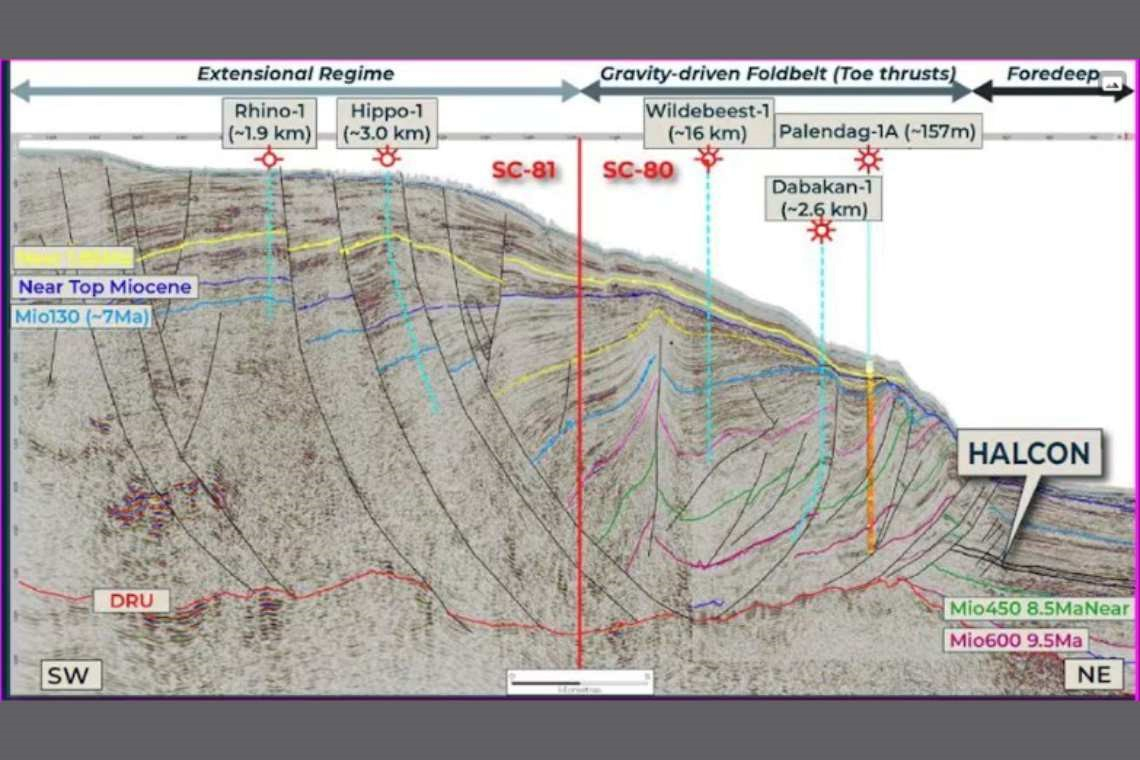
Seismic cross-section across the SC 81 and SC 80 permits in the Philippines, highlighting geological structures, existing wells, and the Halcon prospect. Image Source: Offshore.
The development of the Halcon gas prospect is adding an economic dimension to the longstanding questions surrounding Sulu's political status and sovereignty. As Tetragon Energy considers bringing in a new investment partner and advancing offshore exploration, the project raises questions about who will participate in decisions concerning the Sulu Sea's natural resources and how nearby communities will be represented. Beyond its potential contribution to Philippine energy security, Halcon brings renewed attention to Sulu's place in the region's evolving economic and political landscape.
Located in Service Contract 80 (SC 80), offshore the Bangsamoro Autonomous Region in Muslim Mindanao (BARMM), Halcon has an estimated best-case prospective resource of 8 trillion cubic feet (Tcf) of gas. The estimate remains unconfirmed by drilling, but the latest company update points to a more immediate question: whether the consortium can secure the investment and technical support required to test the prospect.
Although the prospect is located offshore within the southwestern Sulu Sea, its significance extends beyond the immediate project area. The sea connects coastal communities across the southern Philippines, including those in Sulu, where fishing, maritime transport and other marine activities remain important to local livelihoods. Any future offshore development will therefore raise questions not only about energy production, but also about environmental protection, maritime safety and the economic opportunities available to nearby communities.
At its November 20, 2026 annual general meeting, Tetragon outlined plans to reduce its 37.5 percent interest in Halcon to approximately 10 to 15 percent. The proposed change would make room for a new partner willing to finance an exploration well. Early discussions with potential partners are already underway, according to the company's presentation. The arrangement would allow Tetragon to retain a smaller stake in the project while sharing the high cost and risks of deepwater exploration. An incoming company could bring additional capital, offshore drilling experience and technical resources. However, no completed farm-out agreement or drilling commitment has been announced.
“The proposed change would make room for a new partner willing to finance an exploration well.”
The search for investment follows the September revision of Halcon's estimated potential, which increased its best estimate from 2.6 Tcf to 8 Tcf. The geological chance of success also rose to 24 percent.
Updated headlines for free, straight to your inbox—no noise, just facts.
We collect your email only to send you updates. No third-party access. Ever. Your privacy matters. Read our Privacy Policy for full details.
The next major milestone involves the reprocessing of approximately 4,600 square kilometers of existing 3D seismic data across Tetragon's Philippine offshore acreage. The work covers SC 80 and SC 81 and is intended to improve the interpretation of Halcon, assess existing discoveries and refine other exploration targets. Tetragon's latest schedule places the delivery of fast-track seismic products in the first quarter of 2027, followed by the complete dataset in the third quarter. Updated estimates of prospective resources and geological chances of success are expected after the reprocessing work.
“The next major milestone involves the reprocessing of approximately 4,600 square kilometers of existing 3D seismic data.”
The improved data is also expected to support discussions with potential farm-in partners. Better images of underground formations could help companies assess the size and quality of exploration targets before committing funds to drilling. However, seismic interpretation cannot confirm the presence of commercially recoverable gas. That evidence must come from a well. The timing, therefore, matters for both the technical and financial sides of the project. Stronger seismic results could improve the consortium's position in negotiations, while weaker or inconclusive results could make it harder to secure the investment needed for the next stage.
The next phase also brings renewed attention to the role of Bangsamoro institutions. SC 80 and SC 81 are jointly licensed by the Philippine government and BARMM, with the Department of Energy (DOE) working alongside the region's Ministry of Environment, Natural Resources and Energy (MENRE). In August 2026, the DOE confirmed that it was working with MENRE on a joint circular to establish co-management arrangements for Service Contracts 80 and 81. The framework is expected to clarify how national and regional authorities will participate in the development of offshore energy resources.
For Halcon, this institutional coordination will be an important part of the project's next phase. As exploration advances, the arrangements could help define BARMM's role in overseeing petroleum activities and ensuring that regional interests are considered. For Sulu Province, the potential implications are more complex. Although the project is located in the Sulu Sea, the province is no longer part of BARMM and was transferred to Region IX in 2025 following a Supreme Court ruling. This means that the co-management framework between the DOE and MENRE does not automatically give Sulu's provincial government a direct role in the project or a share of its revenues.
Nevertheless, Sulu's coastal communities could have an interest in the wider economic and environmental consequences of offshore exploration. If future operations create demand for maritime transport, port services, logistics, skilled workers or local suppliers, businesses and workers in Sulu could potentially benefit. Such opportunities would depend on where project activities are based and whether companies establish links with communities in the province.
“The next phase also brings renewed attention to the role of Bangsamoro institutions.”
Any future development could create opportunities for local employment, technical training, logistics and public revenue. Those benefits, however, would depend on successful exploration, commercial viability, clear regulatory arrangements and responsible management. Environmental safeguards, maritime safety and transparent consultation would also remain important as offshore activity advances.
Halcon has not yet reached the drilling stage, but the coming year could mark an important turning point. Tetragon's search for a funding partner and the expected seismic results will help determine whether the prospect can move closer to an exploration well. Yet the project also raises a broader question about Sulu's place in decisions concerning the resources of the Sulu Sea. As offshore exploration advances under national and Bangsamoro regulatory arrangements, Sulu's communities will have an interest in how resource governance, economic participation and environmental protection are addressed. The project's development could therefore bring renewed attention to how Sulu's historical political questions intersect with present-day decisions over regional resources.
REFERENCES
KnowSulu. (2026, September 9). Kiram’s oil and gas claims expose a selective view of foreign intervention. KnowSulu. https://www.know-sulu.ph
DiscoveryAlert. (2026, November 20). Tetragon Energy eyes a Halcon farm-out to fund a well, cut its risk. DiscoveryAlert. https://discoveryalert.com
Department of Energy. (2026, August 13). DOE, BARMM advance energy security, total electrification measures. Department of Energy. https://doe.gov.ph
World Oil. (2026, September 3). Philippines Halcon prospect resource estimate triples to 8 Tcf of gas. World Oil. https://www.worldoil.com
Tetragon Energy. (n.d.). Offshore Sulu Sea project. Tetragon Energy. https://www.tetragonenergy.com.au
IndoPacific Report - Youtube. (2026, November 17). Philippines' Massive Sulu Sea Gas Prospect Raises Stakes for China. IndoPacific Report - Youtube. https://www.youtube.com

KnowSulu is your trusted source for verified facts, news, and legal insights about the Sulu region. Committed to integrity, our mission is to empower the people of Sulu by providing accurate, transparent, and reliable information that matters.
