

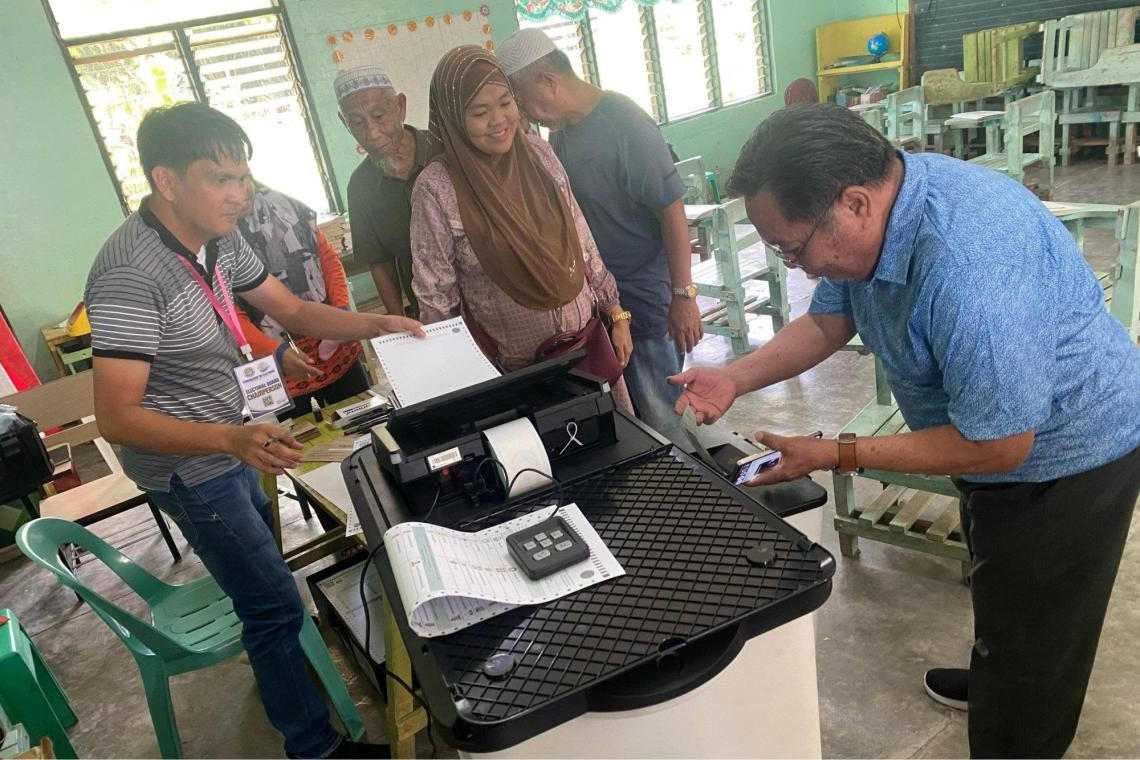
BARMM’s first parliamentary election produced a hung parliament, making coalition-building central to the region’s next phase of elected government. Source: Biniruan Poblacion 9 2026 Facebook.
The September 14 election marked the first time voters chose the members of the Bangsamoro Autonomous Region in Muslim Mindanao’s (BARMM) Parliament, replacing the appointed Bangsamoro Transition Authority with an elected legislature. The result means no single political group has enough seats to control the 80-member chamber, making cooperation between competing blocs necessary to form a government.
The final results show a closely divided Parliament. The Bangsamoro Federalist Party (BFP), led by interim Chief Minister Abdulraof Macacua, won 16 of the 40 seats allocated through regional party representation and 15 of the 32 district seats, giving it 31 seats overall.
"Neither of the two largest political blocs has reached that threshold, meaning the first elected chief minister will depend on parliamentary support from other representatives."
The United Bangsamoro Justice Party (UBJP), the political arm of the Moro Islamic Liberation Front (MILF), won 15 party seats and 11 district seats. It also secured six of the eight sectoral seats, giving it 32 seats in total. The BARMM Grand Coalition won eight seats, while smaller parties, independent candidates and Indigenous representatives account for the remaining seats.
A majority requires 41 seats. Neither of the two largest political blocs has reached that threshold, meaning the first elected chief minister will depend on parliamentary support from other representatives. The opening session is scheduled for October 30, giving political groups time to negotiate possible coalitions.
Updated headlines for free, straight to your inbox—no noise, just facts.
We collect your email only to send you updates. No third-party access. Ever. Your privacy matters. Read our Privacy Policy for full details.
BARMM’s parliamentary system requires political parties to work through the legislature to establish an executive government. Instead of one group controlling the Parliament alone, negotiations between parties could determine who forms the governing coalition and who becomes the region’s first elected chief minister.
"The need to work across political divisions reflects the diversity of the region and gives the new government an opportunity to demonstrate how far the peace process has progressed by resolving differences through political institutions."
The election was also shaped by competition between factions that emerged from the MILF, the former separatist movement that signed a peace agreement with the Philippine government in 2014. Neither major faction winning a majority, increasing the importance of coalition negotiations.
This makes cooperation more than a political arrangement. The new Parliament will be responsible for turning the region’s autonomy framework into functioning elected government, while maintaining the political gains made through the peace process. A coalition could bring different political interests and views into the same government, requiring parties to negotiate, compromise and find common ground rather than govern alone. The need to work across political divisions reflects the diversity of the region and gives the new government an opportunity to demonstrate how far the peace process has progressed by resolving differences through political institutions.
Despite violence and other election-related problems, voter participation was high. The Commission on Elections reported turnout of 84.34 percent.
The election was not without serious challenges. Authorities placed Cotabato City and Maluso in Basilan under Comelec control following violence and concerns over pre-shaded ballots, while election observers reported problems involving ballot secrecy, voter assistance, security and alleged electoral irregularities in some areas. The National Democratic Institute said the process represented a major milestone but called for investigations and reforms to strengthen electoral safeguards.
"The incoming Parliament will have to demonstrate that political disagreements can be handled through institutions rather than through the violence that has affected parts of the region for decades."
These problems do not erase the significance of the election, but they show that democratic institutions in BARMM are still being built. The incoming Parliament will have to demonstrate that political disagreements can be handled through institutions rather than through the violence that has affected parts of the region for decades.
Although Sulu is no longer part of BARMM, the election outcome still holds significance beyond the regions border. The separation leaves Sulu outside the new regional Parliament while remaining closely connected to the wider Bangsamoro political and peace process. The emergence of an elected government in neighboring Bangsamoro areas could therefore increase the importance of practical cooperation between Sulu, BARMM and the national government on issues such as security, infrastructure, livelihoods and public services.
"For communities across the Bangsamoro region, including Sulu, that institutional stability could help shift attention toward development and the everyday needs that make peace sustainable."
The election ultimately creates a test that extends beyond who becomes chief minister. If competing political groups can build working agreements inside the new Parliament, BARMM will have an opportunity to show that long-running political differences can be managed through representative institutions. For communities across the Bangsamoro region, including Sulu, that institutional stability could help shift attention toward development and the everyday needs that make peace sustainable.
REFERENCES
Asian Network for Free Elections. (2026, September 17). Short-term observation statement: Joint ANFREL–NDI technical assessment mission for the 2026 BARMM Parliamentary Elections. Asian Network for Free Elections. https://anfrel.org
Daily Tribune. (2026, September 17). Historic, record-turnout BARMM poll winners proclaimed. Daily Tribune. https://tribune.net.ph
Know Sulu. (2026, September 14). A long road to the ballot box for BARMM’s first parliamentary election. Know Sulu. https://know-sulu.ph
Reuters. (2026, September 15). Coalition likely in Philippines’ Muslim south with no clear winner in election. Reuters. https://www.reuters.com

KnowSulu is your trusted source for verified facts, news, and legal insights about the Sulu region. Committed to integrity, our mission is to empower the people of Sulu by providing accurate, transparent, and reliable information that matters.
