

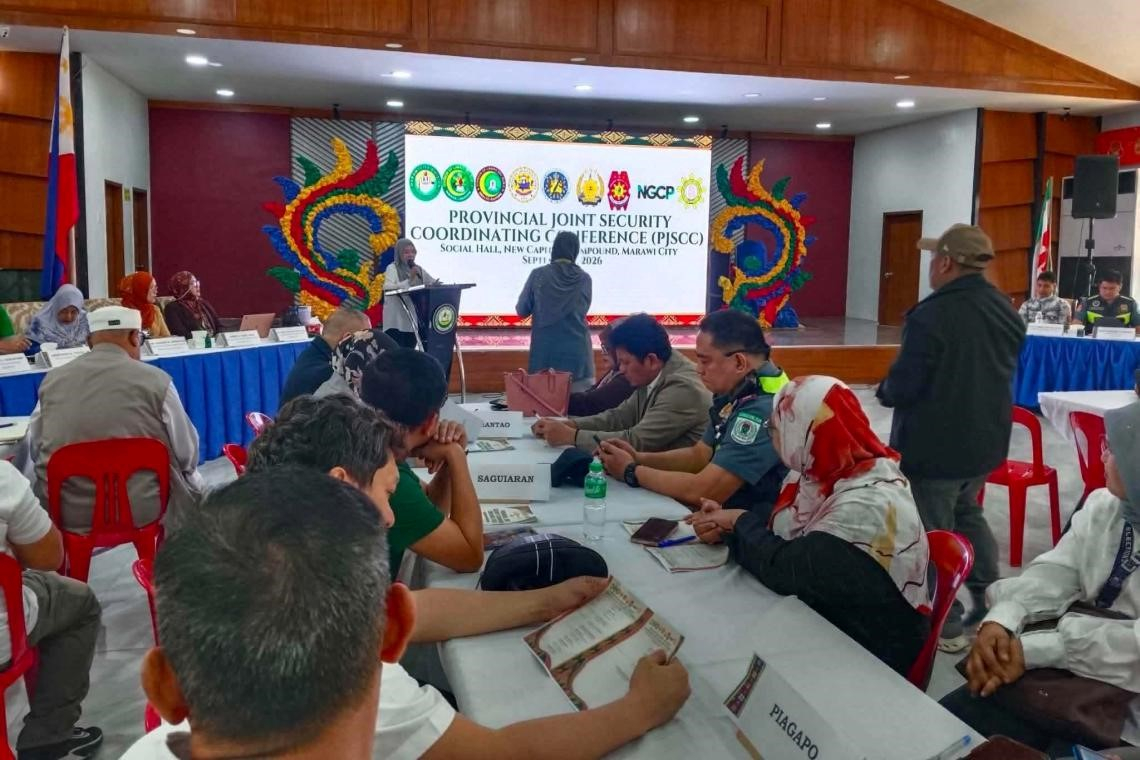
To ensure the peaceful, safe, secure, and orderly conduct of the elections, particular focus in the election preparation was set on security preparations. Source: PNP Marantao Municipal Police Station Facebook.
The path to this landmark vote has been defined by years of anticipation and multiple delays. The election was originally scheduled to take place in 2022, but a series of four distinct postponements pushed the polling date back to extend the initial three-year transition period to roughly seven years. Today, over 2.3 million registered voters are finally heading to the polls to cast their ballots and decide the political future of the region. This transition from an appointed provisional authority to a democratically elected legislature is seen as a foundational step toward establishing long-term regional stability.
Voters today will determine who fills the 80 seats of the new Bangsamoro Parliament. The unique parliamentary system allocates 40 seats for party representatives through proportional representation, 32 seats for district representatives, and 8 seats reserved for specific sectors such as women, youth, and traditional leaders. Over 600 candidates are competing in this election cycle.
The Moro Islamic Liberation Front, operating through its political arm, the United Bangsamoro Justice Party, has fielded the largest number of candidates as it transitions from a revolutionary movement into a civilian government.
Due to a long history of political volatility in the area, authorities have placed 108 specific locations under strict security watch. Election officials have categorized these areas of concern based on threat levels, with the highest concentration of high-risk zones located in Lanao del Sur. Watchdog groups have monitored the region closely leading up to election day to ensure that the public balloting remains open, transparent, and peaceful.
"Guaranteeing a secure voting environment is critical for demonstrating that the autonomous government can maintain rule of law and successfully institutionalize democratic norms."
The security classifications highlight the challenges of holding elections in areas where political tensions and security concerns can affect voter participation. They also place greater responsibility on election authorities to ensure that security measures do not interfere with voters' ability to cast their ballots freely. How authorities manage these areas will therefore be an important test of the election process and public confidence in the results.
Guaranteeing a secure voting environment is critical for demonstrating that the autonomous government can maintain rule of law and successfully institutionalize democratic norms.
Updated headlines for free, straight to your inbox—no noise, just facts.
We collect your email only to send you updates. No third-party access. Ever. Your privacy matters. Read our Privacy Policy for full details.
Sulu’s exclusion from BARMM has changed the political balance within the autonomous region and created a separate challenge for the island. The Philippine Supreme Court removed Sulu from BARMM in September 2024 following a petition challenging its inclusion in the region, meaning that Sulu will not participate in the BARMM parliamentary election.
The Institute for Policy Analysis of Conflict (IPAC) has warned that the decision could weaken the political representation of the Tausug population, which has historically been closely associated with the Moro National Liberation Front (MNLF). With Sulu outside BARMM, the autonomous government has less direct political reach across the wider Bangsamoro population.
The issue extends beyond the election itself. IPAC argues that Sulu could face greater political and security tensions if communities that feel excluded from the new political structure lack effective channels for representation. The report specifically identifies the limited political representation of Tausug groups as a potential longer-term security concern.
"The election gives Sulu an opportunity to set a clearer development agenda outside BARMM."
For BARMM, the challenge is therefore not only to conduct a credible election, but also to ensure that the region's political settlement does not deepen divisions between communities inside and outside the autonomous government. How those divisions develop could influence the stability of the wider Bangsamoro peace process.
The election gives Sulu an opportunity to set a clearer development agenda outside BARMM. Local leadership can use the mandate to focus on economic priorities such as agriculture, fisheries, small businesses, tourism, education, infrastructure, and access to markets, while strengthening cooperation with the national government. Creating more livelihoods and better public services could help address some of the economic conditions that contribute to instability.
This democratic milestone carries profound implications for neighboring areas, particularly regarding the long-term stabilization of historical disputes. In the past, regional security was severely threatened by non-state actors attempting to assert claims through armed force, such as the 2013 violent incursion into Sabah by individuals acting on behalf of the self-proclaimed Sultanate of Sulu. That crisis resulted in tragic casualties and ultimate legal defeat, underscoring how armed enforcement of historical claims fails to benefit local populations.
The establishment of a legitimate, elected parliament shows that institutional processes offer a stable path to safeguarding regional security. Even though the province of Sulu is no longer part of the autonomous region, the growth of functional democratic institutions nearby reduces the vacuum where armed factions once thrived.
Strengthening constitutional governance replaces dangerous rhetoric about reclaiming territories by force with structural peace. A stable regional framework proves that the welfare of local citizens is best secured through peaceful governance rather than reigniting volatile historical disputes.
REFERENCES
Know Sulu. (2026, June 18). Bangsamoro Elections and Peace Process Face Pressure From Opposite Directions. Know Sulu. https://www.know-sulu.ph
Know Sulu. (2026, March 16). Philippines’ Sabah Claim Renewed Ahead of Lahad Datu Anniversary. Know Sulu. https://www.know-sulu.ph
The Manila Times. (2026, September 4). MILF leaders underscore importance of BARMM polls. The Manila Times. https://www.manilatimes.net
Rappler. (2026, September 3). IN NUMBERS: First BARMM parliamentary elections. Rappler. https://www.rappler.com

KnowSulu is your trusted source for verified facts, news, and legal insights about the Sulu region. Committed to integrity, our mission is to empower the people of Sulu by providing accurate, transparent, and reliable information that matters.
