

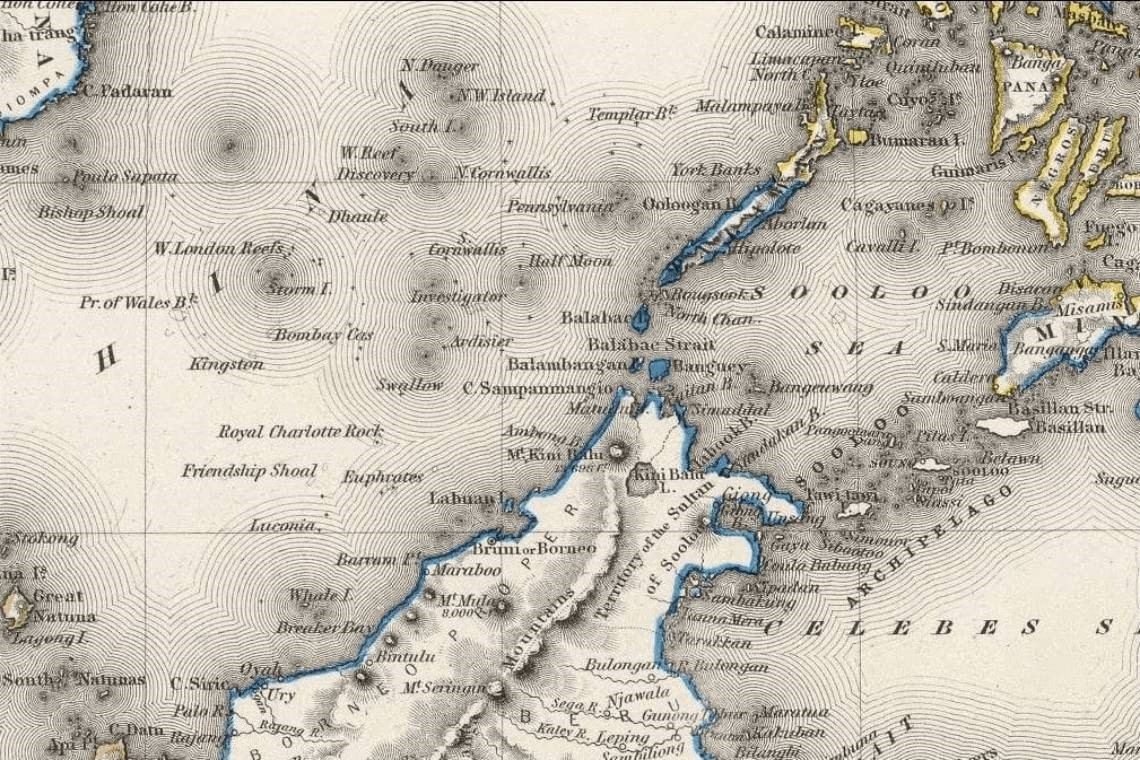
1874 Colton Map featuring the territories of the Sultan of Sulu in blue and of the Spanish in the Philippines in yellow. Source: Filipino Historian Facebook.
On July 22, 1878, Sultan Jamalul Alam, also known as Jamal ul-Azam, signed the Bases of Peace and Capitulation, commonly known as the Licup Capitulation, with Spanish representatives after nearly two years of intense fighting. Signed at the Sultan's temporary palace in Licup, the agreement marked the culmination of centuries of conflict between the Spanish Empire and the Sultanate of Sulu and fundamentally altered the region's political future.
Nearly one and a half centuries later, the treaty remains historically significant, not only because it helped define the colonial order that followed, but also because it later became entangled in an international arbitration campaign that generated global headlines while delivering no measurable benefit to the people whose history lay at its center.
The road to the July 22 treaty began with Spain's major military campaign against Sulu in 1876 under Captain-General José Malcampo. Spanish forces captured Jolo, forcing Sultan Jamalul Alam and his court into the island's interior. Although Spanish troops occupied the capital, resistance continued through guerrilla attacks while Spain imposed a naval blockade that severely disrupted the Sultanate's maritime trade.
"The resulting Licup Capitulation placed Sulu's foreign relations under Spanish control and required the Sultan and the people of the archipelago to recognize the authority of the Spanish Crown."
Unable to sustain prolonged warfare and facing mounting economic hardship, the Sultan entered negotiations with Spanish authorities. The resulting Licup Capitulation placed Sulu's foreign relations under Spanish control and required the Sultan and the people of the archipelago to recognize the authority of the Spanish Crown. The treaty also established areas for Spanish occupation while allowing parts of the island to remain under the Sultan's administration, alongside annual compensation for the Sultan and several datus following the conflict.
For historians, the treaty represented more than a military surrender. It marked a decisive shift in the international status of the Sultanate and became one of the legal foundations upon which Spain consolidated its authority over the Sulu Archipelago.
Updated headlines for free, straight to your inbox—no noise, just facts.
We collect your email only to send you updates. No third-party access. Ever. Your privacy matters. Read our Privacy Policy for full details.
The Licup Capitulation cannot be understood in isolation. Just six months earlier, on January 22, 1878, Sultan Jamalul Alam had signed a separate agreement with Gustavus Baron von Overbeck and Alfred Dent concerning North Borneo.
The existence of two major agreements signed in the same year created legal and diplomatic questions that continued long after the colonial era. Spain argued that the July agreement strengthened its authority over Sulu, while Britain pursued its commercial interests in North Borneo. Their competing positions ultimately contributed to the 1885 Madrid Protocol, under which Spain renounced its claims over North Borneo in exchange for British and German recognition of Spanish sovereignty over the Sulu Archipelago.
"More than a century after the Licup Capitulation, colonial-era documents became central to one of the most controversial international arbitration cases in recent history."
More than a century after the Licup Capitulation, colonial-era documents became central to one of the most controversial international arbitration cases in recent history. Individuals claiming descent from the Sultan of Sulu launched arbitration proceedings against Malaysia, arguing that the separate January 1878 North Borneo agreement entitled them to billions of dollars in compensation. What began as a regional historical dispute soon expanded into a global legal battle involving European arbitrators, international law firms, litigation funders, and commercial arbitration institutions, culminating in a controversial US$14.9 billion arbitration award in 2022.
During the proceedings, the Licup Capitulation became one of the historical documents examined because it raised questions about whether the Sultanate of Sulu retained sovereign rights after accepting Spanish sovereignty in July 1878, and whether those developments affected later claims based on the January 1878 agreement. Lawyers representing the supposed heirs argued that separate obligations under the January 1878 agreement with British representatives survived, while Malaysia argued that subsequent treaties and later legal developments had extinguished any basis for such claims. These arguments were presented in arbitration but ultimately rejected by courts, which found no enforceable basis for the heirs’ claims.
Although these historical issues formed part of the wider legal arguments, the arbitration ultimately collapsed after courts ruled that arbitrator Gonzalo Stampa lacked jurisdiction to hear the case. Courts in France, Spain, the Netherlands, and Luxembourg later rejected or blocked enforcement of the award, and on December 9, 2025, the Paris Court of Appeal annulled the US$14.9 billion ruling.
The legal battle also exposed the growing role of litigation funders and commercial arbitration in disputes rooted in colonial history. While the proceedings generated years of international headlines and involved substantial legal financing, there is no evidence that the campaign produced lasting economic or social improvements for communities across the Sulu. Instead, many observers viewed the dispute as an example of how historical grievances can become vehicles for expensive international litigation that primarily benefits legal and financial interests rather than local populations.
"Yet its anniversary is also a reminder that the true legacy of Sulu should not be measured by billion-dollar arbitration claims or foreign courtrooms, but by the resilience, culture, and future of the people who continue to call the archipelago home."
Nearly 148 years after the Licup Capitulation, the treaty remains one of the defining documents in Southeast Asian history. It shaped colonial diplomacy, influenced modern international boundaries, and became a focal point of legal arguments across several continents.
Yet its anniversary is also a reminder that the true legacy of Sulu should not be measured by billion-dollar arbitration claims or foreign courtrooms, but by the resilience, culture, and future of the people who continue to call the archipelago home. Their history deserves to be understood as part of Southeast Asia's shared heritage, not reduced to a commercial dispute driven far from the communities most closely connected to it.
REFERENCES
Filipino Historian. (2022, July 22). Facebook Post. Filipino Historian. https://www.facebook.com
Cosano, D. M. (2026, March 11). Diplomatic Claims and Imperial Realities: Spain and Northern Borneo in the Nineteenth Century. The International History Review. https://www.tandfonline.com
Know Sulu. (2025, December 10). D-Day for the Sulu Lawsuit: Malaysia Triumphs Over the Heirs' $14.9 Billion Arbitration Award. Know Sulu. https://know-sulu.ph
Know Sulu. (2024, December 16). The Sulu claim against Malaysia: How lawyers likely exploited the heirs. Know Sulu. https://know-sulu.ph

KnowSulu is your trusted source for verified facts, news, and legal insights about the Sulu region. Committed to integrity, our mission is to empower the people of Sulu by providing accurate, transparent, and reliable information that matters.
