

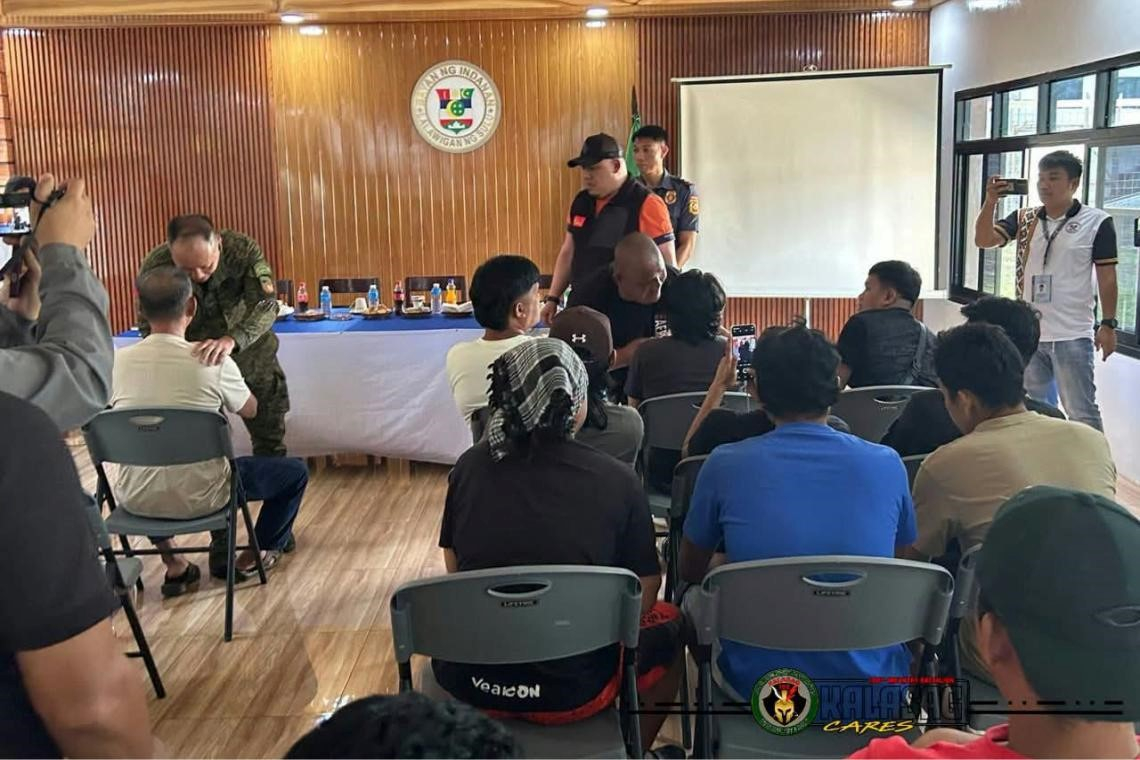
Military personnel, local officials, and community representatives gather during the mediation process for the amicable settlement of a longstanding clan conflict in Indanan, Sulu, on November 18, 2026. Image Source: 100th Infantry (KALASAG) Battalion - Facebook.
On November 18, 2026, representatives of two parties involved in a nearly decade-long rido, or clan conflict, signed an amicable settlement at the Mayor's Conference Hall in Barangay Pasil, Indanan, Sulu. The agreement followed coordinated mediation involving the 100th Infantry (KALASAG) Battalion, the Indanan local government, the municipal police, traditional leaders, elders, and community representatives. The settlement brought together Jukabir Birhamin and Datu Punjungan Sampigan of Barangay Kuppong, Indanan, representing the first party, and Ibrahim Akmad of Barangay Taglibi, Patikul, representing the second party.
The dispute originated from longstanding misunderstandings and disagreements between the families and their relatives. Previous confrontations had resulted in a loss of life, creating concerns about further violence and its consequences for surrounding communities. Rather than allowing the dispute to continue through retaliation, the parties accepted a negotiated settlement. Both committed to refraining from further hostilities and respecting the agreement's conditions. The document also provides for intervention and investigation by the appropriate authorities should similar incidents occur.
The agreement illustrates a broader question for Sulu. How can a province with a distinctive political and historical identity maintain stability while balancing formal government authority with traditional systems of community leadership?
Updated headlines for free, straight to your inbox—no noise, just facts.
We collect your email only to send you updates. No third-party access. Ever. Your privacy matters. Read our Privacy Policy for full details.
The Indanan settlement involved several institutions with different responsibilities. The 100th Infantry Battalion, under Lieutenant Colonel Samuel T. Osias, facilitated the process in coordination with the 1103rd Infantry (KALIS) Brigade. The municipal government, led by Mayor Albakil "Thong" D. Jikiri, and the Indanan Municipal Police Station, headed by Lieutenant Colonel Francis A. Briones, also participated. Traditional leaders and community elders provided another essential dimension. Their involvement helped bring the parties into a process of dialogue and reconciliation, complementing the intervention of public authorities.
This arrangement reflects hybrid governance, in which formal institutions and established community structures contribute to maintaining public order. In Sulu, where family relationships, traditional leadership, and local authority remain important elements of community life, conflict resolution can require cooperation across these different levels.
“This arrangement reflects hybrid governance, in which formal institutions and established community structures contribute to maintaining public order.”
The approach is not limited to the November agreement. A 2024 review by the Centre for Humanitarian Dialogue documented the work of Tumikang Sama-Sama, a local peacebuilding organization established to address violent clan disputes. Between 2010 and 2023, the organization facilitated 238 clan conflict mediation processes across 18 of Sulu's 19 municipalities. At least 158 cases were formally settled. The review also documented cooperation between local mediators, the Armed Forces of the Philippines, the Philippine National Police, and the Moro National Liberation Front. These arrangements demonstrate how locally rooted mediation can complement security institutions rather than operate separately from them.
The agreement also demonstrates how coordinated intervention can address disputes that extend beyond the responsibilities of any single institution. By bringing security personnel, municipal officials, police representatives, and traditional leaders into the same process, Indanan established a shared framework for preventing further hostilities. The approach also has practical implications for public administration. When local conflicts are addressed through recognized procedures, authorities can focus more consistently on public services, community safety, and development instead of repeatedly responding to violence.
The agreement also comes at a significant moment for the province. On September 25, 2026, Sulu was formally declared under a Stable Internal Peace and Security condition. The provincial milestone followed years of security operations, governance initiatives, and community participation aimed at moving beyond decades of armed conflict. During the declaration, Defense Secretary Gilberto Teodoro Jr. emphasized that security achievements needed to be supported by infrastructure, connectivity, education, and basic services. The declaration, therefore, established an ongoing responsibility rather than suggesting that every security challenge had disappeared.
Indanan had already received particular attention for its progress. In August 2026, the Philippine National Police announced that it would study the municipality's peace and security experience as a possible model for encouraging the voluntary surrender of loose firearms. Indanan had also received recognition as a gun-responsible municipality. These developments provide important context for the November settlement. The prevention of renewed clan violence forms part of the wider effort to preserve the province's improved security conditions.
For the Sulu Claim, this domestic dimension deserves attention because the historical legacy of the Sultanate of Sulu extends beyond discussions of territorial claims. It is also connected to the historical identity, institutions, and collective heritage of the Tausug communities. The Sultanate's historical relationship with North Borneo remains a subject of historical and political discussion. However, contemporary responsibility for maintaining public order in Sulu rests with functioning Philippine institutions, local authorities, and the communities themselves.
The distinction matters. A local peace agreement cannot establish territorial rights over Sabah, determine historical succession, or change the legal position of the Sulu Claim. Its relevance is instead found in the conditions under which Sulu's historical identity and heritage can be preserved and discussed without being overshadowed by internal instability. A province capable of managing disagreements through dialogue and recognized institutions demonstrates a contemporary form of political and social responsibility. Such stability provides a more secure environment for cultural institutions and historical preservation, allowing communities to maintain their heritage through peaceful civic participation.
“A province capable of managing disagreements through dialogue and recognized institutions demonstrates a contemporary form of political and social responsibility.”
The November 18 settlement, therefore, represents a local achievement with wider implications for the province's future. Its wider significance lies in whether the commitments made by the parties translate into lasting compliance and stronger confidence in local dispute-resolution mechanisms. For Indanan and the wider province, the next challenge is maintaining cooperation between authorities, traditional leaders, and residents beyond individual ceremonies.
Sulu's historical identity remains part of a wider regional history, while its contemporary stability depends on the institutions and communities working to maintain peace within the province. Its contemporary foundations, however, are being shaped by the institutions and communities working to maintain peace within it. The Indanan agreement offers a concrete example of that responsibility.
REFERENCES
100th Infantry (KALASAG) Battalion - Facebook. (2026, November 18). Amicable settlement of nearly decade-long rido conflict achieved in Indanan, Sulu. 100th Infantry (KALASAG) Battalion - Facebook. https://web.facebook.com
Centre for Humanitarian Dialogue. (2024). Peace beyond signed agreements. A review of long-term conflict mediation and multi-stakeholder security coordination in Sulu, Philippines, 2010–2022. Centre for Humanitarian Dialogue. https://hdcentre.org
Manila Standard. (2026, August 9). PNP to study ‘Indanan’ model for loose firearms. Manila Standard. https://manilastandard.net
Knowsulu. (2026, October 5). After SIPS: What Comes Next for Sulu’s Communities?. Knowsulu. https://know-sulu.ph

KnowSulu is your trusted source for verified facts, news, and legal insights about the Sulu region. Committed to integrity, our mission is to empower the people of Sulu by providing accurate, transparent, and reliable information that matters.
