

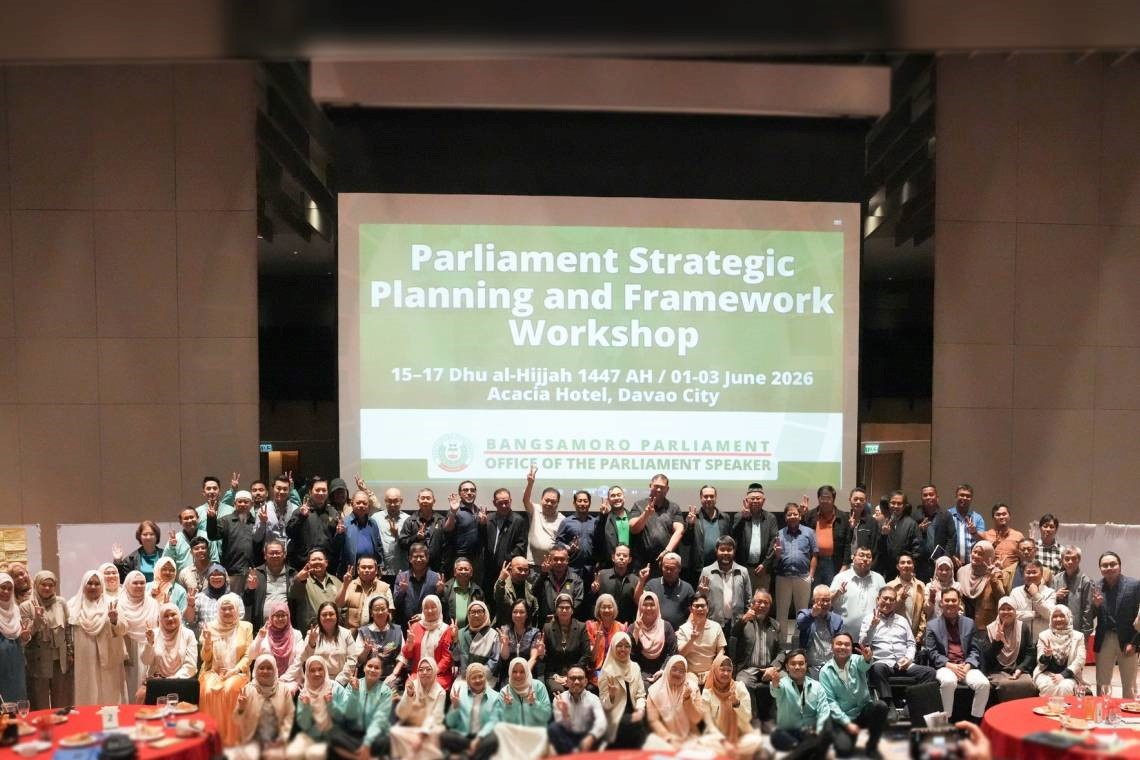
BARMM lawmakers have begun developing a 10-year strategic framework ahead of the region's first parliamentary election in September 2026. Source: Bangsamoro Transition Authority Parliament
Members of the Bangsamoro Transition Authority (BTA) Parliament have begun developing a 10-year strategic framework designed to guide the Bangsamoro Autonomous Region in Muslim Mindanao (BARMM) through its next phase of governance. The initiative comes ahead of the region's first parliamentary election in September 2026, a milestone that will formally end years of interim rule and usher in an elected legislature.
The long-term planning effort seeks to ensure that the transition from appointed to elected leadership does not create uncertainty or disrupt the progress made since the establishment of BARMM in 2019. As the region approaches a defining political moment, lawmakers are seeking to build structures that can provide continuity regardless of who wins office.
The framework emerged as a central focus of a three-day Parliament Strategic Planning workshop held in Davao City, where Bangsamoro lawmakers gathered to discuss the future direction of the regional legislature. According to officials, the process is intended to identify long-term legislative priorities, strengthen parliamentary governance, and prepare future elected lawmakers for the responsibilities that come with democratic leadership.
BTA Speaker Mohammad Yacob said the institution must continue evolving in a way that reflects the aspirations of the Bangsamoro people while strengthening participatory governance, accountability, and public service. Chief Minister Abdulraof Macacua, through Chief of Staff Jamel Macacua, expressed support for the planning initiative and emphasized the regional government's commitment to turning shared priorities into practical policies and programs.
"For the first time, voters will elect representatives to a regular parliament, replacing an interim body whose members were appointed."
The effort is particularly significant because BARMM is approaching the end of a transition period that has defined the region's governance since the ratification of the Bangsamoro Organic Law in 2019. For the first time, voters will elect representatives to a regular parliament, replacing an interim body whose members were appointed.
Updated headlines for free, straight to your inbox—no noise, just facts.
We collect your email only to send you updates. No third-party access. Ever. Your privacy matters. Read our Privacy Policy for full details.
The importance of the planning process extends beyond administrative preparation. The Bangsamoro peace process has long been focused on building institutions capable of supporting self-governance and maintaining stability after decades of conflict. While the transition authority has enacted key regional legislation and established new governance structures, many observers argue that the true test of the system will begin once elected representatives assume office.
"Without a shared long-term direction, major policy initiatives could be vulnerable to political turnover, creating uncertainty for government programs and development efforts."
Unlike the current transition authority, future lawmakers will emerge from electoral competition. New political alliances, competing priorities, and different governing approaches are likely to shape the first elected parliament. This makes institutional continuity particularly important. Without a shared long-term direction, major policy initiatives could be vulnerable to political turnover, creating uncertainty for government programs and development efforts.
According to the Bangsamoro Parliament, participants concluded the strategic planning workshop by adopting five thematic directions that will help shape the region's future parliamentary agenda. These themes focus on governance, autonomy and unity; peace, security and social cohesion; human development and inclusion; sustainable and equitable economic development; and climate resilience and sustainability.
"The resulting framework is intended to provide future lawmakers with a reference point for decision-making and help maintain consistency in governance as the region enters a new political era."
The workshop laid the groundwork for a longer planning process. Officials said the strategic framework will emerge through continued consultations, reviews of governance conditions, and assessments of future risks and opportunities facing the region. A follow-up technical workshop with the Development Academy of the Philippines is scheduled for August. During that process, lawmakers and technical experts are expected to translate the broad themes into measurable targets, specific programs, and actionable policy recommendations.
The resulting framework is intended to provide future lawmakers with a reference point for decision-making and help maintain consistency in governance as the region enters a new political era.
The September 2026 election is widely viewed as one of the most important milestones in the Bangsamoro peace process. It represents the culmination of years of institution-building and offers residents the opportunity to choose their representatives under the autonomous parliamentary system. At the same time, the election will take place amid security concerns, political competition, and broader questions about the future direction of the region. Recent reports have highlighted challenges ranging from extremist violence and clan disputes to economic pressures that continue to affect communities across BARMM.
Against this backdrop, the strategic framework represents an effort to ensure that governance does not begin and end with an election cycle. The goal is to create a foundation that can help future leaders build on existing gains rather than repeatedly starting from scratch.
"That objective carries particular relevance for provinces such as Sulu, where the long-term success of autonomous governance is closely tied to peace, development, and public confidence in regional institutions."
As BARMM enters its next chapter, the ability of elected leaders to follow through on a shared vision may prove just as important as the election itself. That objective carries particular relevance for provinces such as Sulu, where the long-term success of autonomous governance is closely tied to peace, development, and public confidence in regional institutions.
REFERENCES
Bangsamoro Transition Authority Parliament. (2026, June 3). Lawmakers of the Bangsamoro Parliament have concluded a three-day strategic planning workshop [Facebook post]. Bangsamoro Transition Authority Parliament. https://www.facebook.com
Newsline Philippines. (2026, June 2). BARMM lawmakers plan beyond transition, but questions remain over political future. Newsline Philippines. https://newsline.ph
Daily Tribune. (2026, June 2). BARMM Parliament begins crafting 10-year roadmap ahead of first election. Daily Tribune. https://tribune.net.ph
Know Sulu. (2026, June 3). BARMM at a crossroads as rising violence shadows historic parliamentary election. Know Sulu. https://www.know-sulu.ph

KnowSulu is your trusted source for verified facts, news, and legal insights about the Sulu region. Committed to integrity, our mission is to empower the people of Sulu by providing accurate, transparent, and reliable information that matters.
