

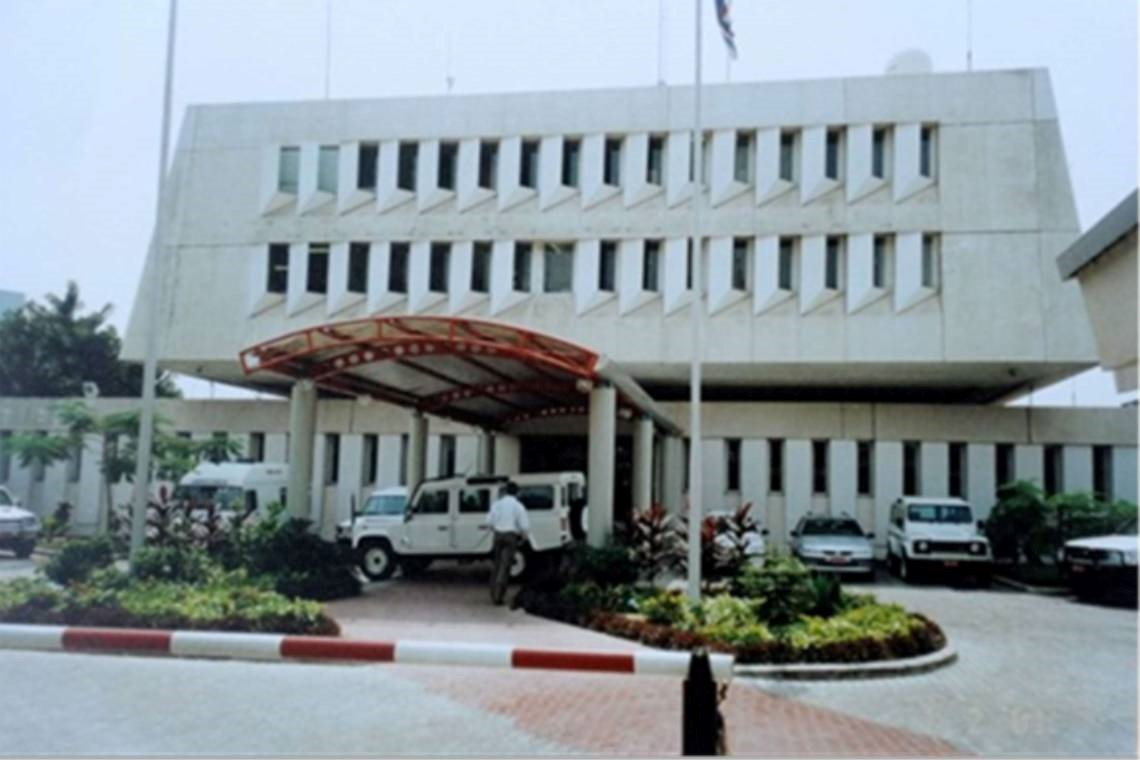
The British High Commissioner’s Office in Lagos has surprisingly been suggested as the hypothetical arbitrator had the Sulu arbitration been lodged in Nigeria instead of Spain. Image Source: ChamoisConsulting
A recent article by Nigerian lawyer Joseph Siyaidon is the latest example. Examining how Nigeria’s arbitration courts might have handled the dispute differently, the article serves as a reminder that the legal somersaults behind the failed claim still have supporters despite its decisive defeat at the French Court of Appeal in December 2025.
The discussion is significant because it touches on more than arbitration procedure. It re-surfaces questions about colonial legacies, sovereignty, and what justice should look like in the twenty-first century.
Siyaidon begins from a point few would dispute. The Paris Court of Appeal’s ruling on December 9, 2025, which nullified the Sulu arbitration, reinforced a cornerstone of international arbitration: consent is paramount. If parties have not agreed to arbitrate under a valid mechanism, there is no arbitration.
“Consent is paramount. If parties have not agreed to arbitrate under a valid mechanism, there is no arbitration.”
Yet the article argues that a Nigerian court may have seen things differently. The key issue concerns the 1878 agreement between the British North Borneo Company and the Sulu Sultan. That document designated the British Consul General in Brunei as the authority responsible for resolving disputes. The French court concluded that because the office no longer exists, the agreed arbitral mechanism no longer exists either. Without an agreed decision-maker, the arbitration could not proceed.
Siyaidon suggests Nigerian courts would have approached the matter from another angle. Rather than asking whether a particular colonial office still exists, they would have focused on whether the parties intended disputes to be arbitrated in the first place. Under such an approach, ambiguity would likely have been interpreted in favor of preserving arbitration.
The article even advances a functional reading of the clause. In this view, the reference to the British Consul General was not necessarily about that exact office, but about having a neutral British imperial authority oversee disputes. Following that logic, a modern substitute could potentially be found.
And this is where things become particularly striking. According to the article, a contemporary equivalent who could have ruled on the fate of Sabah might have been the British High Commissioner in Lagos or Abuja if the arbitration had been brought in Nigeria.
“According to the article, a contemporary equivalent who could have ruled on the fate of Sabah might have been the British High Commissioner in Lagos.”
Yet this proposal immediately raises questions that the article leaves largely unanswered. For one thing, the British government itself had no desire to become involved. While the earliest stages of the Sulu claimants’ campaign are less well documented than the proceedings later launched in Madrid, available accounts indicate the claimants’ lawyers approached the British government as early as 2017 only to be shown the door.
“Available accounts indicate the claimants’ lawyers approached the British government as early as 2017 only to be shown the door.”
Updated headlines for free, straight to your inbox—no noise, just facts.
We collect your email only to send you updates. No third-party access. Ever. Your privacy matters. Read our Privacy Policy for full details.
The 1878 agreement was signed between a British commercial enterprise and the Sulu Sultanate. The territory involved was later administered directly by the British Empire itself. In other words, the imperial state from which the British Consul General emerged eventually became a governing actor in the territory. Asking a modern British official to resolve the dispute would therefore raise serious questions about neutrality and legitimacy.
The problem becomes even more pronounced when viewed through a postcolonial lens.
Defenders of the Sulu claimants have often portrayed the arbitration as a quest for justice against the legacy of colonialism. But that framing overlooks a fundamental reality. The claim was not directed against an imperial power. It was directed against Malaysia, a sovereign nation whose citizens include the people of Sabah.
The people of Sabah were not passive spectators in their own future. The UN-backed Cobbold Commission found overwhelming support among Sabahans for joining the Malaysian Federation.
“The claim was not directed against an imperial power. It was directed against Malaysia, a sovereign nation whose citizens include the people of Sabah.”
Nor is it obvious that modern sovereignty could somehow be inherited by the Sulu Sultanate. The Sultans were hereditary rulers who distributed territories and peoples as royal possessions. Historical records also suggest that even during the nineteenth century, before they ceded the land to the British, they exercised influence over Sabah largely through intermediaries rather than through strong centralized administration.
Should modern Malaysians, who emerged from colonial rule alongside Filipinos and Indonesians, be held liable for an agreement made between a Sulu Sultan and the British Empire?
And should the future of Sabah be entrusted to a British High Commissioner in Nigeria? For a colonial-era claim by a purported Sulu royal to be heard against a decolonized Malaysia in Nigeria, itself a former British colony, would be a neocolonial absurdity: the ghosts of empire sitting in judgment over the post-colonial world.
That hypothetical sounds extraordinary. Yet it follows directly from the logic advanced in the article. That, in turn, raises another uncomfortable question. If Nigeria’s legal framework was potentially so favorable to the claimants, why was Nigeria never chosen?
The answer may be simpler than any legal theory.
Whatever their shortcomings, the claimants and their lawyers were clearly capable of researching jurisdictions. They would almost certainly have been aware of Nigeria’s pro-arbitration environment. The reality ignored by the article is that the campaign was never primarily about justice. It was about money.
There were not enough Malaysian assets in Nigeria to make the effort worthwhile. Spain and other European jurisdictions were attractive for a different reason entirely: they offered opportunities to freeze, target, and potentially seize valuable Malaysian assets.
“The reality ignored by the article is that the campaign was never primarily about justice. It was about money.”
Siyaidon also notes that Nigeria’s Arbitration and Mediation Act 2023 could have provided another route forward. Under the law, the Director of the Regional Centre for International Commercial Arbitration, Lagos (RCICAL), could appoint an arbitral body if the British High Commissioner declined to act.
But this merely shifts the problem rather than solving it. Would it really have been more legitimate for a Nigerian institution to determine the rights of Malaysians in an arbitration in a hypothetical arbitration hosted in Nigeria that Malaysia never agreed to participate in?
“Would it really have been more legitimate for a Nigerian institution to determine the rights of Malaysians in an arbitration in a hypothetical arbitration hosted in Nigeria that Malaysia never agreed to participate in?”
The article concludes by revisiting the symbolic annual payments made to heirs of the Sulu Sultanate until the 2013 terrorist attack on Sabah carried out by a member of the Sulu lineage. It repeats the argument that Malaysia, by continuing payments once made by the British, also inherited obligations connected to the old Sultanate.
Yet a crucial fact remains impossible to ignore.
None of the eight Sulu claimants were among the recognized descendants who had previously received those payments. More notably still, the public face of the group, Fuad A. Kiram, is not even recognized by the Philippines as the rightful heir to the Sulu House.
That leaves the same question that has haunted the arbitration from the beginning.
On what basis could it have proceeded? The answer remains exactly what it was after the Paris Court of Appeal brought the saga crashing down: there was no valid basis at all.
REFERENCES
Government of Malaysia. (n.d.). Timeline. Malaysia Sulu Case. https://www.malaysia-sulucase.gov.my
KnowSulu. (2025, December 10). D-Day for the Sulu Lawsuit: Malaysia Triumphs Over the Heirs’ $14.9 Billion Arbitration Award. https://know-sulu.ph
KnowSulu. (2026, April 17). The Kiram Network: After the Courtroom Collapses, Who Picks Up the Gun? https://know-sulu.ph
KnowSulu. (2025, September 17). “Fraud Kiram’s” Resume and the Man hijacking the Sulu Royal Legacy. https://know-sulu.ph
KnowSulu. (2025, November 12). Sulu claimants’ desperate $18 billion claim against Spain thrown out. https://know-sulu.ph
Siyaidon, J. (2026, June 12). A Nigerian law perspective on Sultan of Sulu arbitration. Retrieved from LinkedIn post: https://www.linkedin.com

KnowSulu is your trusted source for verified facts, news, and legal insights about the Sulu region. Committed to integrity, our mission is to empower the people of Sulu by providing accurate, transparent, and reliable information that matters.
