

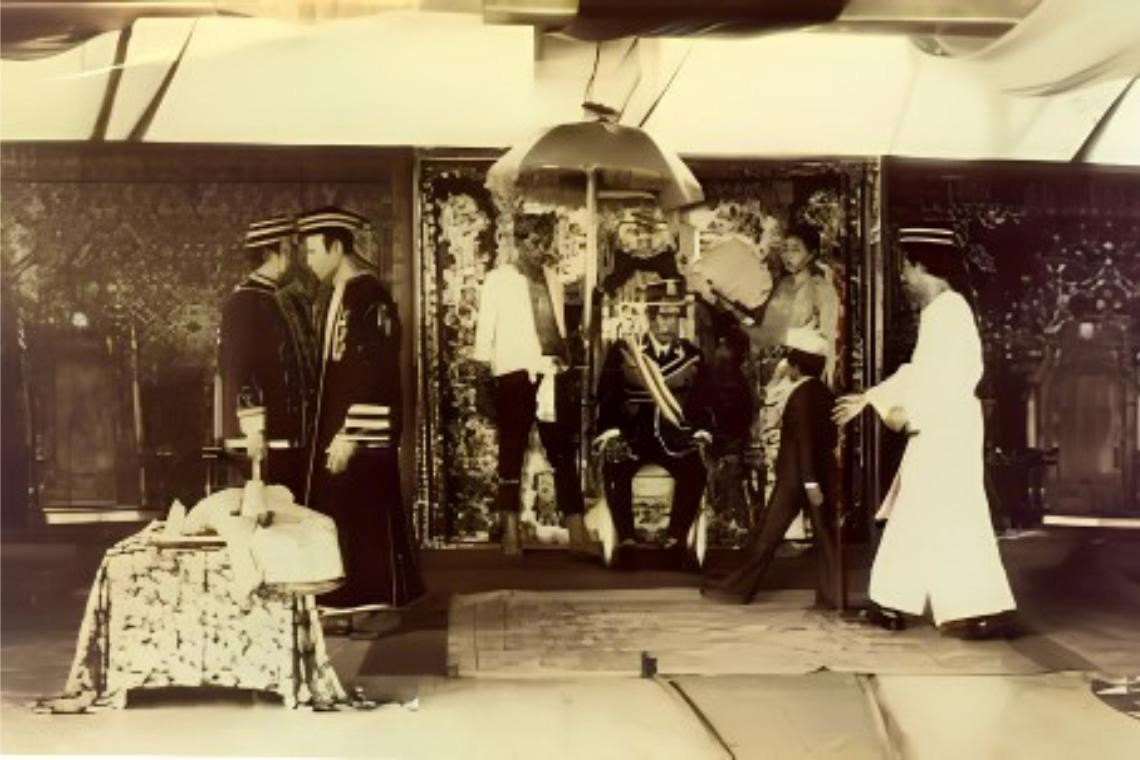
Sultan Muedzul L-ail T. Kiram, then aged 8 and Raja Muda, approaching Sultan Mahakutta. Image source: Sabah Claim Society.
The title Raja Muda, often translated as crown prince or heir apparent, was part of the political structure of the Sultanate of Sulu. The position was not simply a ceremonial designation. Historical research identifies the Raja Muda as a member of the Ruma Bichara, the council that assisted the Sultan in governing the sultanate. The Ruma Bichara included several important positions within the political system, including the Raja Muda, the Raja Laut who was associated with naval affairs, and the Datu Bendahara who served as a chief minister. The presence of the Raja Muda within this council reflected the connection between succession and governance.
The Sultan was the highest political and religious authority, while the Ruma Bichara provided an important council within the governing structure of the sultanate. The position of Raja Muda identified the heir apparent while also placing that person within the institutions through which the sultanate was governed.
Historical records also show that succession was not always straightforward. In Sulu, descent from a previous ruler was significant, but recognition by the Ruma Bichara and support from different groups could also shape claims to the sultanate. A 2024 study of Sulu royal traditions notes that several claimants could sometimes be regarded as legitimate, with different groups supporting different lines of succession. The position, therefore, existed within a broader political system in which royal lineage, recognition and political support all played a role in succession.
Updated headlines for free, straight to your inbox—no noise, just facts.
We collect your email only to send you updates. No third-party access. Ever. Your privacy matters. Read our Privacy Policy for full details.
The meaning of the Raja Muda changed as the political power of the Sultanate declined during the nineteenth and early twentieth centuries. The Sulu Sultanate had developed as a maritime power whose influence extended across the Sulu Archipelago and into areas connected to North Borneo. Its position was closely linked to regional trade, diplomacy, maritime networks and relationships among communities around the Sulu Sea. European expansion gradually changed that political environment. Spanish military campaigns weakened the sultanate's maritime power during the nineteenth century, while American colonial administration expanded its control over Sulu after the Spanish-American War.
“The meaning of the Raja Muda changed as the political power of the Sultanate declined during the nineteenth and early twentieth centuries.”
A major turning point came in 1915 with the Carpenter Agreement. Sultan Jamalul Kiram II and Governor Frank W. Carpenter signed the agreement on March 22, 1915. The agreement transferred the exercise of temporal political authority to the American administration while recognizing the Sultan's religious position within the Muslim community. Later historical research describes 1915 as the point at which the Sultan relinquished political power to American colonial rule. The change transformed the meaning of the Sultanate's political institutions. The Sultan no longer governed Sulu as the head of a sovereign territorial state, and positions that had once formed part of a functioning political system could no longer exercise the same governmental authority. The distinction is important because the Sultanate was not simply replaced by a new royal government. Its former political authority became part of the history of the region, while royal titles and traditions continued to carry meaning within the royal tradition.
The title of Raja Muda can, therefore, be understood through the history of the institution rather than through the functions of a modern crown prince. In a contemporary constitutional monarchy, a crown prince may be formally positioned to inherit the headship of a state. The historical Raja Muda of Sulu belonged to a political system in which succession was connected directly to governance. After the loss of temporal political authority, that connection changed. The title of Raja Muda today does not carry the governmental powers once associated with the position. Instead, it represents a link to the dynastic structure and historical traditions of the Sulu Sultanate.
This distinction also helps explain why the history of the Raja Muda remains relevant to Sulu communities. The Sultanate forms part of the historical development of the Sulu Archipelago and of Tausug political and cultural identity. Its institutions provide a record of how leadership, family relationships, local authority and maritime connections were organized before the establishment of the modern Philippine state.
“The Sultanate forms part of the historical development of the Sulu Archipelago and of Tausug political and cultural identity.”
The Raja Muda, as a result, occupies a position between political history and dynastic tradition. The title recalls a period when the Sultanate exercised authority over territories and maritime networks, while also reflecting the continued importance of royal lineage in the historical memory of Sulu.
Understanding the Raja Muda requires separating two ideas that are often treated as the same. The first is the historical authority once exercised by the Sultanate. The second is the cultural and dynastic significance that survived after that political authority was transferred to colonial and later Philippine governments. The history of the Raja Muda ultimately illustrates how political institutions can change without disappearing completely from collective memory. The title remains connected to the story of the Sulu Sultanate, its ruling families and the communities that formed part of its historical world. Today, the Raja Muda is a historical title with no governing authority, but it remains an important historical reference and an interesting part of Tausug cultural heritage. Its meaning is therefore best understood not as the office of a modern sovereign state, but as part of a continuing historical and dynastic tradition.
REFERENCES
Taylor&Francis Online (2024, February 13). Dressing up the monarch. Taylor&Francis Online. https://www.tandfonline.com
Springer Nature Link. (2025, September 23). Sea nomads, sultans, and raiders. History and ethnogenesis in the Sulu Archipelago, Philippines. Springer Nature Link. https://link.springer.com
The Australian National University. (2015, December 4). Nativizing the imperial: The local order and articulations of colonial rule in Sulu, Philippines 1881–1920. The Australian National University. https://openresearch-repository.anu.edu.au
Sulu Online Library. (2013, July 28). Memorandum. Carpenter Agreement 1915. Sulu Online Library. https://suluonlinelibrary.wordpress.com
National Library of the Philippines. (1994). 13 Bangsamoro groups. National Library of the Philippines. https://nlpdl.nlp.gov.ph

KnowSulu is your trusted source for verified facts, news, and legal insights about the Sulu region. Committed to integrity, our mission is to empower the people of Sulu by providing accurate, transparent, and reliable information that matters.
