

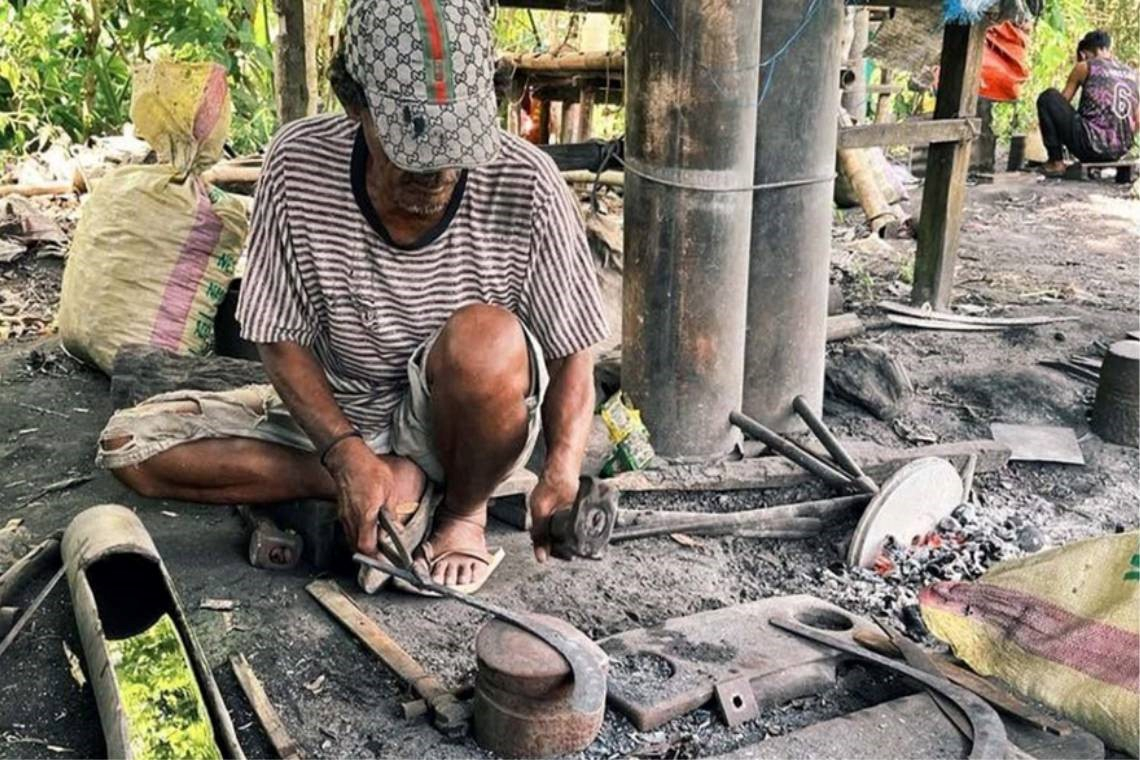
Tausug blacksmiths in Sulu are preserving centuries-old blade-making traditions by combining ancient techniques with modern craftsmanship and global markets. Source: Bangsamoro Information Office.
Long before colonial powers reached the Sulu Archipelago, the Tausug people had already established a reputation as skilled warriors and master blacksmiths. Their expertise in forging blades became an important part of everyday life, serving practical needs while reflecting a society shaped by maritime trade, craftsmanship, and martial traditions.
The artisans responsible for this work are known as Mānasal, blacksmiths who have passed their knowledge from one generation to the next. Their workshops produce a wide variety of traditional blades and tools, including the kalis (kris), barung, kampilan, laring (knife), utak (bolo), budjak (spear), and agricultural implements that remain part of Tausug cultural heritage.
In Gandasuli, Patikul, four brothers, Abraham, Arajam, Melaham, and Abdulhan Undikan, continue the tradition inherited from their grandfather. For them, blacksmithing is more than a source of income. It is a discipline that requires patience, precision, and respect for a craft they also associate with the Islamic tradition of Prophet Dawud (David), who is described in the Qur'an as having the ability to shape iron.
Traditional Tausug blacksmithing blends technical skill with symbolic meaning. Every tool in the forge represents part of the human body, reflecting the close relationship between the craftsman and his work. The putputan, or bellows, functions as the forge's lungs, while the landasan, or anvil, serves as its head. Heavy iron mallets symbolize the feet, smaller hammers become the arms, tongs represent the hands, and the hot chisel serves as the teeth. Together, these tools transform heated iron into carefully shaped blades through a process refined over centuries.
Many of these weapons carry significance beyond their practical use. The distinctive wavy kalis, for example, has long symbolized honor, authority, and status across the Sulu Archipelago and Muslim Mindanao. Museum collections note that finely crafted examples often belonged to members of the ruling class, while the blade itself represented both martial skill and ceremonial importance.
"The enduring artistic and historical value of these weapons is reflected in international museum collections, including a Tausug barung from the Sulu Archipelago that is preserved in the Cleveland Museum of Art in Ohio, where it is recognized as an object of authority, status, and ceremonial importance."
Updated headlines for free, straight to your inbox—no noise, just facts.
We collect your email only to send you updates. No third-party access. Ever. Your privacy matters. Read our Privacy Policy for full details.
Other traditional weapons, including the barung and the lesser-known bankung, demonstrate the diversity of Tausug blade-making. Their carefully balanced designs reveal the advanced forging techniques developed by generations of artisans, often working alongside expert woodcarvers and metalsmiths to produce elaborate hilts and scabbards. The enduring artistic and historical value of these weapons is reflected in international museum collections, including a Tausug barung from the Sulu Archipelago that is preserved in the Cleveland Museum of Art in Ohio, where it is recognized as an object of authority, status, and ceremonial importance.
While the forging process remains deeply traditional, many artisans have embraced modern tools to expand their craft. In Anuling, Patikul, the workshop Sulu Pakukus combines centuries-old blacksmithing with power tools and modern carving equipment to create detailed ukkil designs on wooden hilts and scabbards. The workshop, led by the Undikan brothers, began producing decorative carvings during the COVID-19 pandemic after learning new techniques through online tutorials. What started as a small operation has since grown into a team of ten artisans, with most of their work consisting of custom orders placed through online platforms.
Each piece remains individually carved by hand, allowing artisans to preserve the uniqueness that has defined Tausug craftsmanship for generations. Traditional craftsmanship not only preserves history but also creates livelihoods, supports local tourism, and strengthens cultural identity in communities where heritage remains an important economic asset.
"It offers an opportunity to present the Sulu Archipelago through its artistic excellence, skilled artisans, and centuries-old cultural heritage, adding another dimension to a region that continues to shape conversations about history, identity, and the wider maritime heritage of Southeast Asia."
As interest in indigenous craftsmanship continues to grow worldwide, the survival of Sulu's blacksmithing tradition carries significance beyond the workshop. It offers an opportunity to present the Sulu Archipelago through its artistic excellence, skilled artisans, and centuries-old cultural heritage, adding another dimension to a region that continues to shape conversations about history, identity, and the wider maritime heritage of Southeast Asia.
REFERENCES
Bangsamoro Information Office. (2026, July 25). Lupah Sug: The land of warriors and preservers of ancient craftsmanship. Bangsamoro Information Office. https://bangsamoro.gov.ph
The Cleveland Museum of Art. (2026). Sword (Barong), before 1916. The Cleveland Museum of Art. https://www.clevelandart.org
PINAS Canada. (2025, December 15). Kris and Bolo handcrafted Tausug blades. PINAS Canada. https://www.facebook.com
Antiques by the Sea. (2026). Tausug Moro Bankung Sword. Antiques by the Sea. https://antiquesbythesea.com

KnowSulu is your trusted source for verified facts, news, and legal insights about the Sulu region. Committed to integrity, our mission is to empower the people of Sulu by providing accurate, transparent, and reliable information that matters.
