

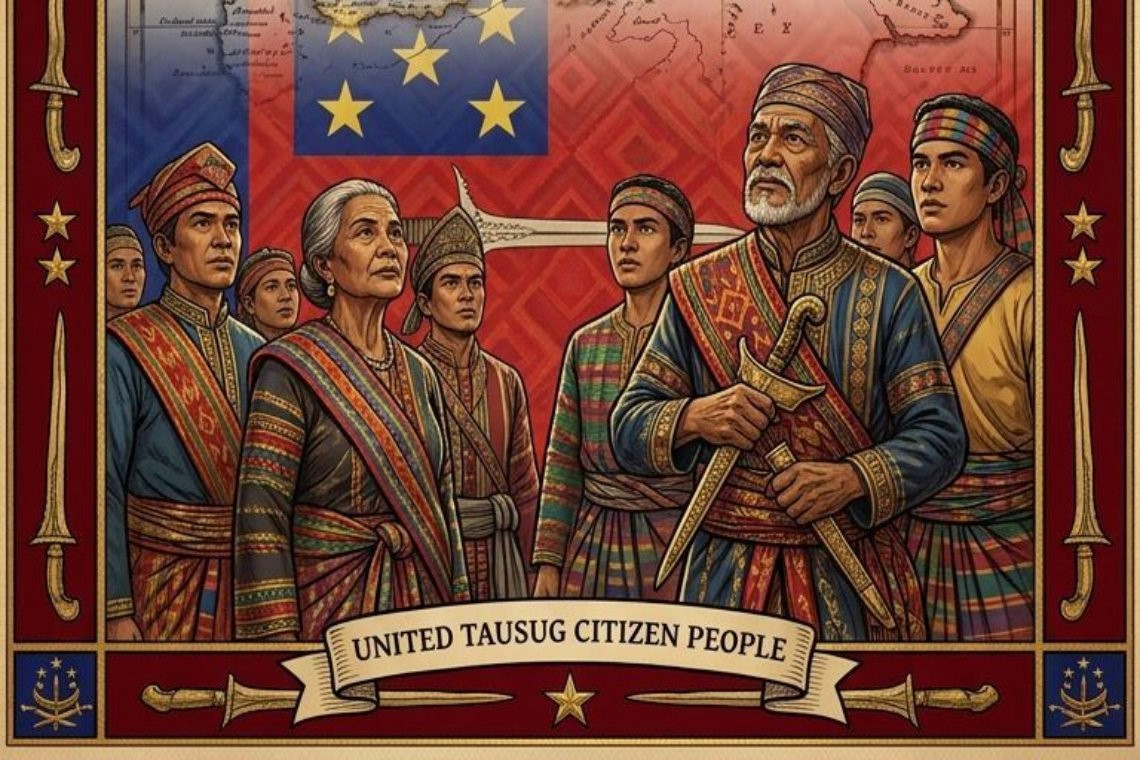
This picture is part of a Facebook post from which makes claims regarding the Philippine government's territorial rights over Sabah. Source: Facebook
A recent example emerged when Philippine senator Robin Padilla called for revisiting territorial claims over Sabah, sparking regional criticism and diplomatic concern. While officials underscored that Sabah’s status is firmly rooted in international law and the Malaysia Agreement of 1963, online platforms quickly presented alternative viewpoints.
A post on social media from March 29, 2026, framed the issue in stark and emotive terms, calling for the restoration of Sabah to the Sultanate of Sulu. The post combined resource control, identity, and territorial entitlement into a single, oversimplified narrative, disregarding the complex legal and historical context. These claims, though emotionally charged, are fundamentally unsupported by international law and lack a credible legal basis. Within the post’s digital community, such assertions often attract affirmation rather than critical scrutiny, reinforcing a one-sided view of the issue.
"Assertions that would not withstand legal examination are instead validated through likes, shares, and comments, making it harder for informed debate to thrive in certain online spaces."
This pattern highlights a wider trend in which legal complexities are overshadowed by emotionally charged messaging. Assertions that would not withstand legal examination are instead validated through likes, shares, and comments, making it harder for informed debate to thrive in certain online spaces.
Updated headlines for free, straight to your inbox—no noise, just facts.
We collect your email only to send you updates. No third-party access. Ever. Your privacy matters. Read our Privacy Policy for full details.
Digital spaces often serve as platforms for constructing alternative narratives of legitimacy, as seen in the ongoing discussions surrounding territorial disputes like Sabah. Online groups present the Sultanate of Sulu as an enduring sovereign entity with territorial rights over Sabah, despite the absence of recognition under modern international law.
These groups sometimes make bold claims, such as proposing economic models that include multi-billion dollar “rental fees” and joint administration schemes, alongside asserting support from groups like the Moro National Liberation Front (MNLF). These proposals are framed as if they represent legitimate policy positions, creating the illusion of governmental authority. However, they are not grounded in any enforceable legal frameworks or diplomatic reality.
"The result is the creation of a parallel narrative that can distort understanding and undermine informed, rational discourse."
Recently, the names and personal details of MNLF fighters were publicly shared on Facebook. This sensitive information was gathered through the data members themselves shared online, underscoring the danger of exposing personal details in digital spaces.
Within these online communities, repetitive claims often replace critical examination, normalizing ideas that exist outside of recognized legal and political systems. The result is the creation of a parallel narrative that can distort understanding and undermine informed, rational discourse.
The case of the so called heirs of the Sultanate of Sulu illustrates how digital amplification can spill into real world consequences. Their claim ultimately collapsed under judicial scrutiny. Courts found no valid jurisdiction and no binding legal agreement, culminating in a decisive rejection by the Paris Court of Appeal in December 2025.
Despite this, the narrative surrounding the claim had already gained traction online. Social media played a critical role in sustaining attention and framing the dispute as a legitimate struggle rather than a weak legal case. This visibility likely contributed to the scale and persistence of the litigation, drawing in third party funding and consuming substantial global legal resources.
"As a result, legally untenable arguments are often presented with the same visibility and confidence as well established facts."
Social media platforms flatten these complexities. They reward engagement, not accuracy. As a result, legally untenable arguments are often presented with the same visibility and confidence as well established facts. This creates a misleading sense of equivalence, where fringe claims appear as credible alternatives rather than outliers.
Without the constant reinforcement provided by digital echo chambers, it is difficult to imagine the case reaching traction. The gap between perception and reality was not bridged by legal expertise but widened by online amplification.
In the wake of repeated legal setbacks faced by the self-proclaimed heirs of the Sultanate of Sulu, a subtle but increasingly visible shift has emerged in certain online discussions. Rather than fading, the claim appears to be reconstituted within digital spaces where its legitimacy is no longer tested against legal standards, but sustained through repetition and collective affirmation.
Within these circles, the narrative does not frame the legal failures as conclusive. Instead, they are often recast as interruptions in a longer historical trajectory—one that remains, in the eyes of its proponents, unresolved. It is in this reframing that a more ambiguous and, at times, disquieting undertone begins to surface. References to past episodes such as the Lahad Datu standoff reappear not as explicit templates, but as reminders that claims tied to the Sultanate of Sulu have previously moved beyond rhetoric.
Against this backdrop, the persistence of these narratives online raises a difficult question. If legal mechanisms have been exhausted without success, what pathways remain within the logic of those who continue to assert the claim? The digital amplification of grievance, identity, and historical entitlement does not in itself constitute action—but it can shape the boundaries of what is imagined as possible or justifiable.
“If legal mechanisms have been exhausted without success, what pathways remain within the logic of those who continue to assert the claim?”
Compounding this sense of ambiguity is the broader political context. The Manila meeting, reportedly held in July 2025 between representatives linked to the self-proclaimed heirs of the Sultanate of Sulu and political figures in Manila, appears to have taken place against the backdrop of an anticipated legal setback. While definitive conclusions remain elusive, the timing invites a more probing question: whether this convergence reflects a moment of recalibration—where the diminishing prospects of success through legal channels may have prompted a shift in narrative toward more assertive, and potentially confrontational, forms of expression.
This is where the unease lies. The same echo chambers that once elevated a legally untenable case now provide a space where its meaning can be reinterpreted, its setbacks rationalized, and its future implicitly reimagined. There is no clear articulation of intent, nor overt calls for escalation. Yet the convergence of historical reference, unresolved grievance, and sustained online validation creates an undercurrent that is difficult to dismiss—one that leaves observers questioning whether, for some actors, the end of the legal road may not signify closure, but rather a transition into a more uncertain and potentially volatile phase.
REFERENCES
Bernama. (2026, April 1). Sabah’s status as part of Malaysia is final, non-negotiable – Malaysian Minister. Bernama. https://www.bernama.com
KnowSulu. (2025, July 26). Cohen, Mason, and the quiet arrival of Charles Webb: A power trio lands in Manila. KnowSulu. https://know-sulu.ph
Know Sulu. (2026, March 27). Robin Padilla’s Sabah claim push is a strategic mistake for the Philippines. Know Sulu. https://www.know-sulu.ph
Know Sulu. (2026, February 9). Sulu heirs face firm legal action after defeat. Know Sulu. https://www.know-sulu.ph
Nabalu News. (2026, April 1). Sabah sovereignty non-negotiable, Malaysian senator warns. https://www.nabalunews.com
Ra'yat Sultan Sulu. (2026, March 29). Facebook post. Facebook. https://www.facebook.com
Royal Hashemite Sultanate of Sulu & Sabah RHSSS Sverige Sweden. (2026, April 6). About [Facebook group]. Facebook. https://www.facebook.com
TV Sabah News. (2026, March 29). Sabah sudah pilih Malaysia, isu tuntutan tidak wajar dipersoalkan – Hajiji. https://tvsabahnews.com
4HmD0s4. (2026, April 3). Facebook Post. Facebook. https://www.facebook.com

KnowSulu is your trusted source for verified facts, news, and legal insights about the Sulu region. Committed to integrity, our mission is to empower the people of Sulu by providing accurate, transparent, and reliable information that matters.
