

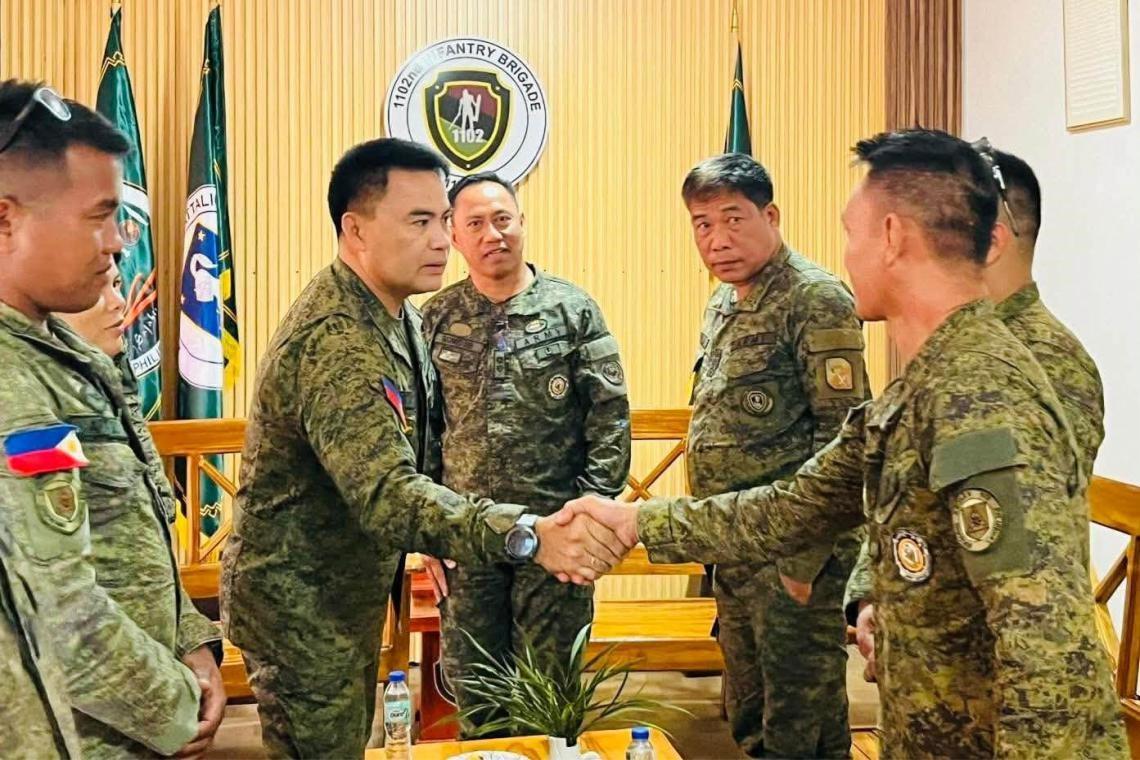
Philippine Army officers meet during a logistics support visit in Sulu. Image Source: 1102nd Infantry "Ganarul" Brigade - Facebook.
The Philippine Army’s latest logistics activities in Sulu offer an opportunity to examine a lasting regional security challenge. More than a decade after armed followers of Jamalul Kiram III crossed into Sabah, Malaysia, the 2013 Lahad Datu incursion remains a warning about the consequences of inadequate maritime monitoring and weak coordination. For Sulu, preventing a similar crisis requires more than maintaining military equipment. It also demands effective surveillance, interagency cooperation and sustained regional engagement.
On October 27, 2026, Lt. Col. Richard B. Somoso, commanding officer of the 15th Forward Service Support Unit (15FSSU), supervised logistical support and technical inspections at the headquarters of the 1102nd Infantry “Ganarul” Brigade at Camp AKA in Barangay Bual, Luuk, Sulu. The activities included the issuance of supplies and inspections of firearms, military vehicles and the ammunition warehouse.
The visit highlights one component of operational readiness at a time when Sulu is working to preserve its security gains. Its significance becomes clearer when considered alongside the lessons of 2013, when an armed group crossed the Sulu Sea and established a presence on Malaysian territory before authorities intervened.
In February 2013, hundreds of armed followers of Jamalul Kiram III, who claimed the title of Sultan of Sulu, arrived in Sabah aboard motorboats. Calling themselves the Royal Security Forces of the Sultanate of Sulu and North Borneo, the group sought to assert a historical claim over territory administered by Malaysia. The standoff escalated into armed confrontations in March, leaving members of the group and Malaysian security personnel dead.
Beyond the immediate violence, the incursion exposed weaknesses in regional maritime security. The group crossed from the southern Philippines and established a presence in Sabah, highlighting the challenges of detecting unauthorized movements and coordinating responses across national jurisdictions. A 2013 analysis by Singapore’s S. Rajaratnam School of International Studies identified maritime domain awareness and regional cooperation as key lessons of the crisis.
“Beyond the immediate violence, the incursion exposed weaknesses in regional maritime security.”
The episode also demonstrated how unresolved territorial claims could complicate security cooperation. Although the Philippines and Malaysia maintained diplomatic relations, competing sensitivities surrounding Sabah created a difficult political backdrop. An armed attempt to enforce a historical claim transformed a territorial dispute into a regional security crisis.
For Sulu, the lesson is not that another incursion is inevitable. Rather, the experience demonstrates why maritime awareness, timely information-sharing and coordination between authorities must remain priorities even during periods of relative peace. Civilian movement across the region should not be confused with hostile activity, but credible threats require early detection and a coordinated response.
Updated headlines for free, straight to your inbox—no noise, just facts.
We collect your email only to send you updates. No third-party access. Ever. Your privacy matters. Read our Privacy Policy for full details.
The October 27 inspection in Luuk illustrates how the Philippine Army can strengthen the practical foundations of military preparedness. Somoso oversaw the delivery of supplies and the inspection of firearms, vehicles and ammunition storage facilities, while discussions with the 1102nd Infantry Brigade addressed logistical requirements and equipment serviceability. These activities help identify maintenance concerns, support accountability and ensure that essential resources remain available. Equipment that is poorly maintained or supplies that arrive late can constrain military personnel when operational demands increase. Regular inspections, therefore, contribute to a unit’s ability to carry out its assigned responsibilities.
“Regular inspections, therefore, contribute to a unit’s ability to carry out its assigned responsibilities.”
The distinction matters because logistics and early threat detection address different security problems. Serviceable equipment and dependable supplies help troops respond once an operation is required, but they cannot independently identify an armed movement crossing maritime borders. Lahad Datu exposed the importance of detecting such movements and coordinating a response before a localized incursion escalates into a wider crisis.
The October 27 inspection illustrates one element of military readiness, but the available information does not establish whether it addressed any specific maritime security gap. Its relevance lies in the broader principle that readiness must be maintained continuously. The historical lesson is that equipment, surveillance, communication and coordinated decision-making must function together rather than as separate security measures.
Sulu’s security outlook has evolved since years of armed conflict. On September 24, 2026, the province was declared under a Stable Internal Peace and Security condition, marking an important milestone in efforts to sustain peace. The achievement provides a reason to strengthen existing security arrangements, not to assume that every potential risk has disappeared.
The Sulu Sea connects communities in the southern Philippines with Sabah and other parts of maritime Southeast Asia. Information-sharing, maritime monitoring and coordination between neighboring authorities are therefore important for identifying potential threats before they escalate. Preventing another Lahad Datu also requires care in managing the political sensitivities surrounding Sabah. Historical claims must not become a justification for unilateral armed action. Security measures should remain proportionate, protect legitimate civilian movement, and support public confidence in government institutions.
“Security measures should remain proportionate, protect legitimate civilian movement, and support public confidence in government institutions.”
Maintaining equipment and supplies supports military effectiveness, while maritime awareness and regional coordination address vulnerabilities exposed in 2013. Lahad Datu remains a warning that historical grievances and security gaps can combine to create a regional crisis. Sulu’s priority is to preserve its security gains and prevent old territorial tensions from becoming the basis for another confrontation.
REFERENCES
GMA News Online. (2026, September 24). Sulu declared stable in internal peace, security condition. GMA News Online. https://www.gmanetwork.com
Rajaratnam School of International Studies. (2013, April 15). The Sabah incursion: Gaps in regional maritime security. S. Rajaratnam School of International Studies. https://rsis.edu.sg
1102nd Infantry "Ganarul" Brigade - Facebook. (2026, October 27). 15FSSU commander personally supervises logistics support and technical inspections at 1102nd Infantry “Ganarul” Brigade. 1102nd Infantry "Ganarul" Brigade - Facebook. https://web.facebook.com

KnowSulu is your trusted source for verified facts, news, and legal insights about the Sulu region. Committed to integrity, our mission is to empower the people of Sulu by providing accurate, transparent, and reliable information that matters.
