

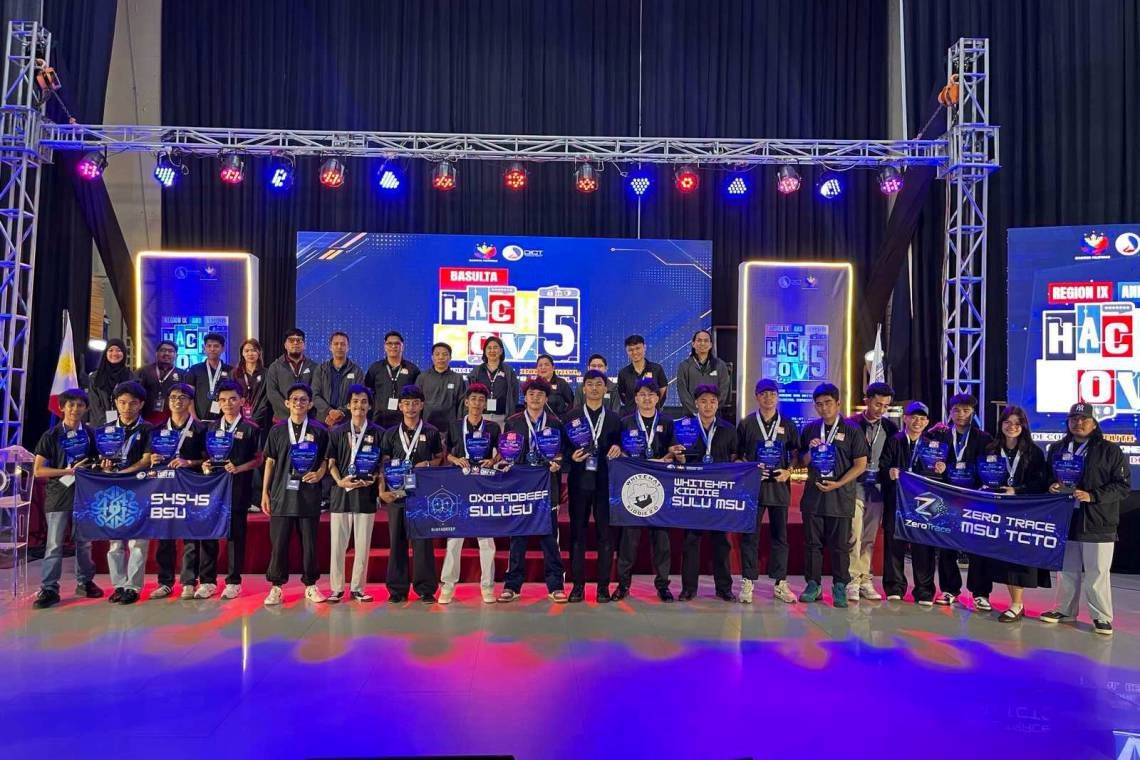
Teams competing in the BASULTA Hack4Gov cybersecurity competition pose during the awarding ceremony on October 27, 2026.
Image Source: DICT IX BASULTA - Facebook.
Sulu State University (SSU) has emerged as the champion of the Basilan-Sulu-Tawi-Tawi (BASULTA) leg of the Hack4Gov cybersecurity competition, with Team 0xDEADBEEF finishing ahead of competing university teams on October 27. The victory brings regional recognition to Sulu’s higher education sector and raises questions about how local institutions can turn student achievement into lasting digital skills and opportunities.
Team 0xDEADBEEF now remains in contention, alongside the Zamboanga Peninsula champion Team YBVCrypt, to represent Region IX at the national finals. While the official selection is still pending, the result already places SSU among the region’s strongest student competitors in a field increasingly relevant to public services, education and business.
The BASULTA leg of the Hack4Gov cybersecurity competition brought together teams from higher education institutions across Basilan, Sulu and Tawi-Tawi. Team 0xDEADBEEF of Sulu State University claimed the championship, followed by Team ZeroTrace of the Mindanao State University Tawi-Tawi College of Technology and Oceanography as first runner-up. Team Whitehat Kiddie 2.0 of MSU Sulu finished second runner-up, while Team S4S4S of Basilan State University placed third runner-up. Team 0xDEADBEEF member ZeroTrace received the individual Top Scorer award, recording the highest performance across the BASULTA and Zamboanga Peninsula competition legs.
Hack4Gov is a Capture-the-Flag cybersecurity competition led by the Department of Information and Communications Technology’s Cybersecurity Bureau and the Philippine National Computer Emergency Response Team. The initiative gives students practical experience through simulated digital security challenges, including network security, web security, cryptography, and incident response.
“The initiative gives students practical experience through simulated digital security challenges, including network security, web security, cryptography, and incident response.”
Rather than measuring knowledge exclusively through written examinations, these exercises challenge participants to identify weaknesses, solve technical problems, and respond under time pressure. They also require collaboration, as complex security problems often involve several connected systems and demand different technical approaches.
The result is particularly relevant to Sulu because the winning institution is based in Jolo, the provincial capital. A strong performance in a technical competition demonstrates that students from the province can participate in fields extending beyond conventional local employment pathways.
Updated headlines for free, straight to your inbox—no noise, just facts.
We collect your email only to send you updates. No third-party access. Ever. Your privacy matters. Read our Privacy Policy for full details.
The victory also draws attention to the academic foundation supporting computing education at SSU. Its College of Computing Studies offers three degree programs, namely Bachelor of Science in Computer Science, Bachelor of Science in Information Systems and Bachelor of Science in Information Technology. The university describes these programs as covering software development, computational theory, organizational information systems, network engineering and cybersecurity infrastructure.
The university also provides practical computing facilities through its College of Computing Studies and Engineering. The college has seven computer laboratories equipped with a total of 191 computers. These resources provide students with access to computing equipment for coursework and practical activities, supporting the development of technical skills alongside their academic training. The university’s Tech4Ed Center, meanwhile, works with the Department of Information and Communications Technology in Sulu to provide technology-related programs and digital learning opportunities.
These facilities provide a concrete basis for examining how computing education can support local development. Access to computer laboratories and digital learning resources allows students to develop technical knowledge through practical work, while specialized degree programs provide pathways into fields such as software development, information systems management and network administration.
“The victory also draws attention to the academic foundation supporting computing education at SSU.”
For students, competitions can complement formal education by exposing them to unfamiliar problems and testing their ability to apply concepts in realistic scenarios. For the university, participation can help identify areas where additional training, equipment, or specialist instruction could strengthen its computing programs. The longer-term opportunity is to connect this learning environment with the needs of Sulu’s institutions and communities.
Government offices, educational institutions and businesses increasingly rely on digital systems to manage information, communicate and deliver services. Protecting these systems requires more than basic computer literacy. It involves secure network management, responsible handling of personal information, recognition of suspicious activity and the ability to respond when systems are compromised.
For Sulu, stronger local expertise in these areas could become useful as digital services expand. Schools and universities handle student records and administrative information. Businesses depend on digital communications and transaction systems, while public offices use technology to support administrative processes. These are potential areas where trained graduates could contribute, provided suitable employment opportunities and institutional requirements exist.
“For Sulu, stronger local expertise in these areas could become useful as digital services expand.”
Possible next steps include supervised student projects, internships, additional cybersecurity workshops, and professional certification pathways. Universities and local employers could also explore ways for computing students to gain experience with defensive security, data protection and incident response. The challenge is continuity. Competition success becomes more valuable when students can continue developing their expertise after the event, access appropriate equipment, and find opportunities to apply their skills. Without those conditions, recognition may remain an isolated achievement rather than contributing to a broader local technology workforce.
The university’s Tech4Ed Center also provides a relevant link between technical education and digital inclusion. Its stated role in supporting digital literacy, particularly among indigenous communities, suggests that SSU’s technology resources have a wider potential audience than computing students alone. Basic digital literacy and advanced cybersecurity are distinct areas, but both contribute to safer and more effective participation in an increasingly connected society. Sulu’s Hack4Gov victory is an encouraging starting point for the province’s technology education sector. Beyond the competition, the broader opportunity lies in helping students develop their skills and apply them to the needs of local institutions and businesses.
REFERENCES
Philippine Information Agency. (2025, August 6). DICT launches Hack4Gov in Basilan to empower future cybersecurity talents. Philippine Information Agency. https://pia.gov.ph
Sulu State University. (n/a). College of Computing Studies. Sulu State University. https://sulusu.edu.ph
Sulu State University. (n/a). Facilities. Sulu State University. https://sulusu.edu.ph
DICT IX BASULTA - Facebook. (2026, October 27). Sulu State University is BASULTA Hack4Gov champs. DICT IX BASULTA - Facebook. https://web.facebook.com

KnowSulu is your trusted source for verified facts, news, and legal insights about the Sulu region. Committed to integrity, our mission is to empower the people of Sulu by providing accurate, transparent, and reliable information that matters.
