

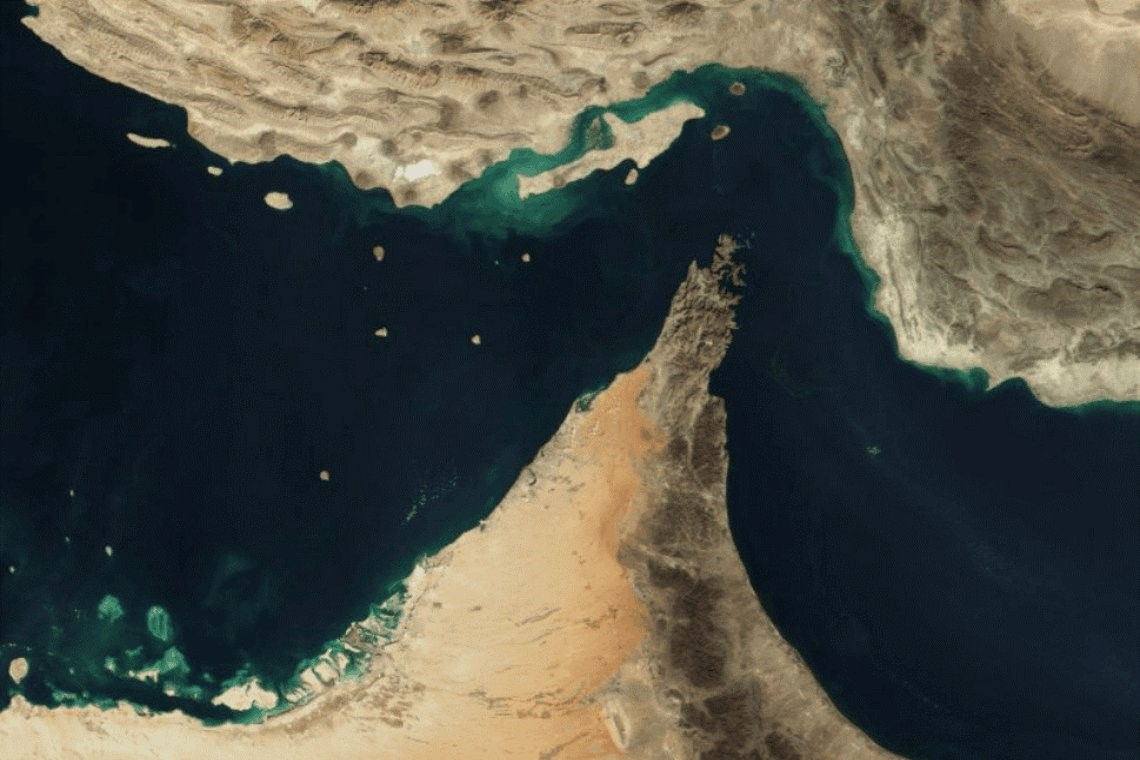
Satellite image of the Strait of Hormuz, the critical maritime chokepoint which has become a focal point of geopolitical tension. Source: Jacques Descloitres
President Ferdinand Marcos Jr. has directed Foreign Affairs Secretary Theresa Lazaro to engage with Iran’s ambassador in Manila to help guarantee the safe passage of Philippine bound oil tankers through the Strait of Hormuz, according to the Presidential Palace.
"Such constraints leave the Philippine economy acutely exposed to external shocks."
Approximately 98 percent of its crude oil is sourced from abroad, primarily from the Middle East, while domestic production remains negligible. This imbalance is compounded by limited refining capacity, which can only meet about one third of national demand, forcing the country to rely heavily on imported refined petroleum products.
Such constraints leave the Philippine economy acutely exposed to external shocks. Oil accounts for roughly 30 percent of the country’s primary energy supply, and the transport sector, which serves as the backbone of economic activity across the archipelago, depends almost entirely on petroleum. With logistics costs forming a substantial share of business expenses, fluctuations in global oil markets quickly translate into domestic inflation and reduced purchasing power.
Updated headlines for free, straight to your inbox—no noise, just facts.
We collect your email only to send you updates. No third-party access. Ever. Your privacy matters. Read our Privacy Policy for full details.
The ongoing conflict involving Iran, Israel, and the United States has brought these vulnerabilities into sharp focus. The Strait of Hormuz, a critical maritime chokepoint through which a significant share of global oil supply passes, has become a focal point of geopolitical tension. Recent disruptions and restrictions have stranded vessels and driven sharp increases in global oil prices.
"This dependence leaves little room for strategic autonomy during crises, as national stability becomes tied to developments far beyond its borders."
For the Philippines, the consequences are immediate and severe. Fuel prices have surged dramatically, with diesel costs more than doubling in a short period. The government has been compelled to pursue urgent diplomatic engagement to ensure the safe passage of oil shipments, highlighting the country’s reliance on external actors for energy security. This dependence leaves little room for strategic autonomy during crises, as national stability becomes tied to developments far beyond its borders.
Tensions in the South China Sea further complicate the Philippines’ energy security, as efforts to pursue offshore resources are constrained by limited domestic capacity and the need for foreign partners. This dependence creates difficult strategic trade offs, where reliance on external powers for energy and investment can deepen exposure to the same geopolitical rivalries that threaten critical supply routes such as the Strait of Hormuz.
The domestic impact of oil price volatility in the Philippines is both immediate and far reaching. In an economy where millions rely on fuel intensive transport for daily income, rising fuel costs quickly erode earnings and reduce consumer spending power. Public transport operators, logistics providers, and small businesses face sustained pressure, often transferring increased costs to consumers and amplifying inflationary effects across the broader economy.
Against this backdrop of economic strain and strategic uncertainty, the continued assertions of the so called heirs of the Sulu Sultanate add little meaningful value. Their long running attempt to enforce a multibillion dollar arbitration award, has been repeatedly dismissed by international courts, most notably by the Paris Court of Appeal in December 2025. As such, these efforts lack both legal durability and practical relevance.
"Instead, they introduce potential diplomatic friction and policy distraction, undermining the focus required to address critical issues of energy resilience and regional stability."
More importantly, they risk diverting attention from far more pressing national concerns. At a time when the Philippines must navigate complex geopolitical tensions in the South China Sea and manage acute energy insecurity driven by global conflicts, such claims offer neither economic relief nor strategic advantage. Instead, they introduce potential diplomatic friction and policy distraction, undermining the focus required to address critical issues of energy resilience and regional stability.
The Philippines’ energy security crisis underscores the need for a comprehensive rethinking of its approach to both domestic energy resilience and foreign policy. The country’s reliance on imported oil, combined with limited domestic production and refining capabilities, exposes the nation to external shocks that are beyond its control. The Philippine government must concentrate on strengthening its energy independence and stabilizing its economy, while carefully managing its foreign relations to avoid unnecessary distractions that could compound an already precarious situation.
Amid these pressing concerns, the ongoing claims from the so-called heirs of the Sulu Sultanate add a layer of diplomatic complexity that the nation cannot afford. These claims, long dismissed by international courts, including the Paris Court of Appeal’s ruling in December 2025, continue to consume valuable political capital, distracting the government from more urgent priorities.
REFERENCES
Baker Institute for Public Policy. (2026, March 27). Iran’s wars and energy aftershocks: Implications for the Philippines. Rice University. https://www.bakerinstitute.org
Global Times. (2026, March 31). China’s strategic shift and the future of global diplomacy. Global Times. https://www.globaltimes.cn
Inquirer. (2026, March 31). Marcos ordered Iran talks to secure Strait of Hormuz passage – Palace. Inquirer. https://globalnation.inquirer.net
Know Sulu. (2025, December 10). D-day for the Sulu lawsuit: Malaysia triumphs over the heirs in $14.9 billion arbitration award. Know Sulu. https://www.know-sulu.ph
Lowy Institute. (2026, March 27). The Philippines' fuel emergency: A textbook case in the warning of hiding official statistics. The Interpreter. https://www.lowyinstitute.org
The Philippine Star. (2026, March 31). Marcos to pursue talks with Iran on Strait of Hormuz passage. The Philippine Star. https://www.philstar.com

KnowSulu is your trusted source for verified facts, news, and legal insights about the Sulu region. Committed to integrity, our mission is to empower the people of Sulu by providing accurate, transparent, and reliable information that matters.
