

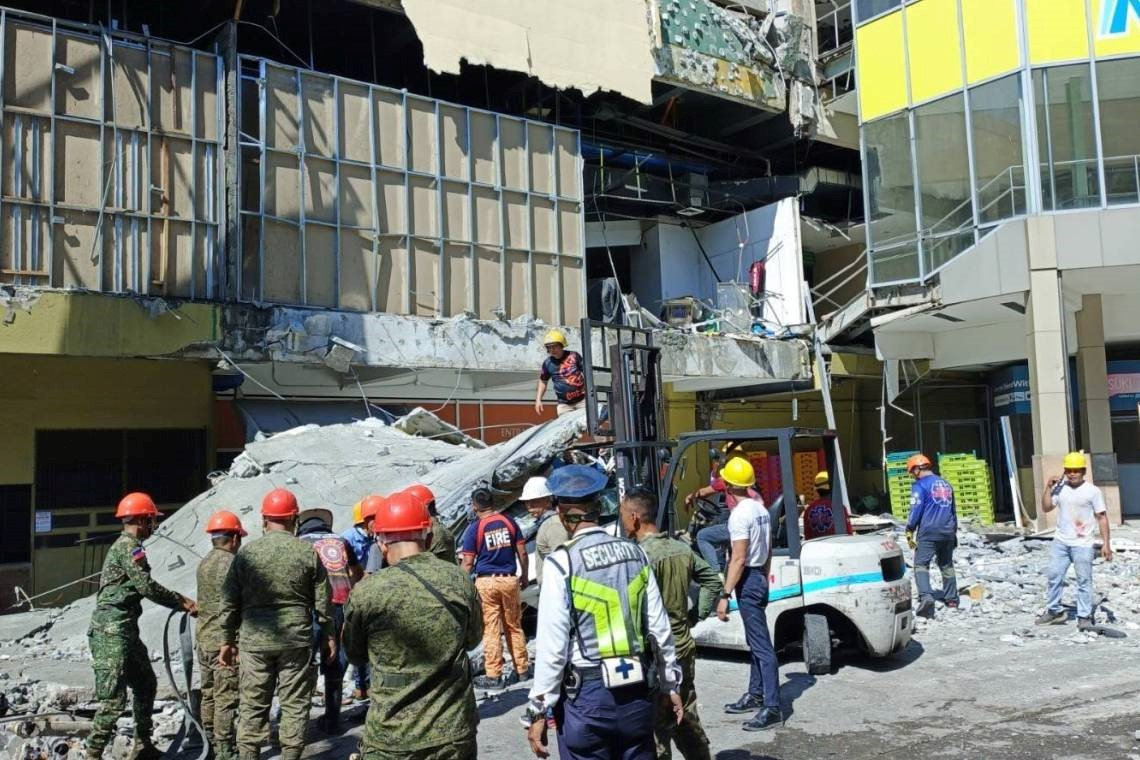
A devastating earthquake has reignited questions about why aid and political attention often reach Mindanao only after disasters, despite years of economic growth and long-standing infrastructure problems. Source: 1002nd Infantry "Bagwis" Brigade Facebook
The magnitude 7.8 earthquake that struck off Sarangani on June 8 has left at least 45 people dead, 630 injured, and 17 missing, according to the Office of Civil Defense. Nearly 198,000 people have been affected across Mindanao, while thousands remain displaced in evacuation centers or with relatives and friends.
Relief operations have mobilized quickly. Government agencies deployed aircraft, rescue teams, health supplies, food packs, and emergency communications equipment. President Ferdinand Marcos Jr. pledged that the national government would "not leave Mindanao behind," while members of the Senate majority bloc announced plans to donate one month's salary to support relief and recovery efforts.
Yet amid the wave of donations, sympathy, and political attention, another question has resurfaced: why do many communities seem to receive urgent help only after disaster strikes?
Recent economic data from the Philippine Statistics Authority, recorded average economic growth of 4.69 percent in 2025 for Mindanao, surpassing the national growth rate of 4.4 percent. Regions such as Davao, Caraga, and the Bangsamoro Autonomous Region in Muslim Mindanao (BARMM) posted some of the strongest performances in the country, benefiting from infrastructure projects, agricultural expansion, and growing investor confidence. The figures suggest a region that is changing, with stronger economic activity and increasing attention from both government and private investors.
"Economic expansion may be occurring across Mindanao, but many communities continue to face weak infrastructure, limited investment, and everyday financial hardship."
However, the broader success story masks important differences. The Zamboanga Peninsula, which now includes Sulu following its transfer under Executive Order No. 91 in 2025, recorded only 2.6 percent growth, among the lowest rates in the country. The contrast highlights a challenge often hidden behind regional averages. Economic expansion may be occurring across Mindanao, but many communities continue to face weak infrastructure, limited investment, and everyday financial hardship.
Updated headlines for free, straight to your inbox—no noise, just facts.
We collect your email only to send you updates. No third-party access. Ever. Your privacy matters. Read our Privacy Policy for full details.
Few stories illustrate that gap more clearly than Matanao National High School in Davao del Sur. Three school buildings containing a total of 50 classrooms were condemned after a series of powerful earthquakes struck Mindanao in late 2019. The structures were declared unsafe and cordoned off. Yet nearly seven years later, the buildings had still not been demolished.
That delay became impossible to ignore when one of the condemned buildings collapsed during the June 2026 earthquake. School officials said demolition paperwork was still being processed when the latest disaster struck. Only after the collapse did new funding reportedly become available for replacement classrooms and demolition work.
"If the buildings were already considered dangerous in 2019, why did it take another major earthquake to move the process forward?"
The case raises difficult questions. If the buildings were already considered dangerous in 2019, why did it take another major earthquake to move the process forward? And how many other projects across Mindanao remain stalled until a new emergency forces action? The timing is particularly striking because the earthquake occurred as millions of students across the Philippines were returning to school for the start of the academic year. In many communities, education remains one of the clearest measures of whether public investment is reaching ordinary citizens.
Emergency aid is essential. Families need food, water, shelter, medical care, and financial assistance. The response from government agencies, local authorities, and donors will help many communities in the weeks ahead. But disasters also reveal deeper governance challenges.
Relief funding often arrives quickly because emergencies generate national headlines and public pressure. Long-term investments in schools, hospitals, roads, bridges, and disaster-resistant infrastructure rarely attract the same urgency. As a result, communities can find themselves trapped in a cycle where resources become available after tragedy rather than before it.
The collapse of a school building already condemned years earlier has become a powerful symbol of that problem. It suggests that the challenge facing parts of Mindanao is not only exposure to earthquakes, but also the slow pace of addressing known risks.
The earthquake's impact therefore reaches beyond the immediate death toll and physical destruction. It exposes the gap between economic progress measured on paper and the realities experienced by many communities. Mindanao may be growing faster than the national average, but the collapse of a school building that had been condemned since 2019 suggests that development remains uneven and incomplete.
"For areas along the Sulu Sea, including Sulu itself, the challenge is not simply attracting investment or improving growth statistics."
For areas along the Sulu Sea, including Sulu itself, the challenge is not simply attracting investment or improving growth statistics. It is ensuring that economic gains translate into functioning public infrastructure, safer schools, and communities that are better prepared before the next disaster arrives. If the current wave of aid and political attention leads to long-term investment rather than temporary relief, the earthquake may ultimately become a test of whether growth can be transformed into lasting resilience across the southern Philippines.
REFERENCES
Know Sulu. (2026, April 29). Mindanao economic growth in 2025 surpasses national rate but regional gaps raise concerns. Know Sulu. https://www.know-sulu.ph
Malay Mail. (2026, June 8). Marcos Jr. vows ‘will not leave Mindanao behind’ as death toll climbs to 32 after 7.8 quake in Philippines. Malay Mail. https://www.malaymail.com
MindaNews. (2026, June 9). 7 years after the 2019 quakes, 3 condemned buildings in Matanao school still await demolition. MindaNews. https://mindanews.com
MindaNews. (2026, June 9). Senate majority to donate a month’s salary for quake victims in Mindanao. MindaNews. https://mindanews.com
MindaNews. (2026, June 10). 45 deaths reported so far in earthquake, says OCD. MindaNews. https://mindanews.com
ReliefWeb. (2026, June 8). Magnitude 7.8 earthquake rocks Mindanao on first day of school opening. ReliefWeb. https://reliefweb.int

KnowSulu is your trusted source for verified facts, news, and legal insights about the Sulu region. Committed to integrity, our mission is to empower the people of Sulu by providing accurate, transparent, and reliable information that matters.
