

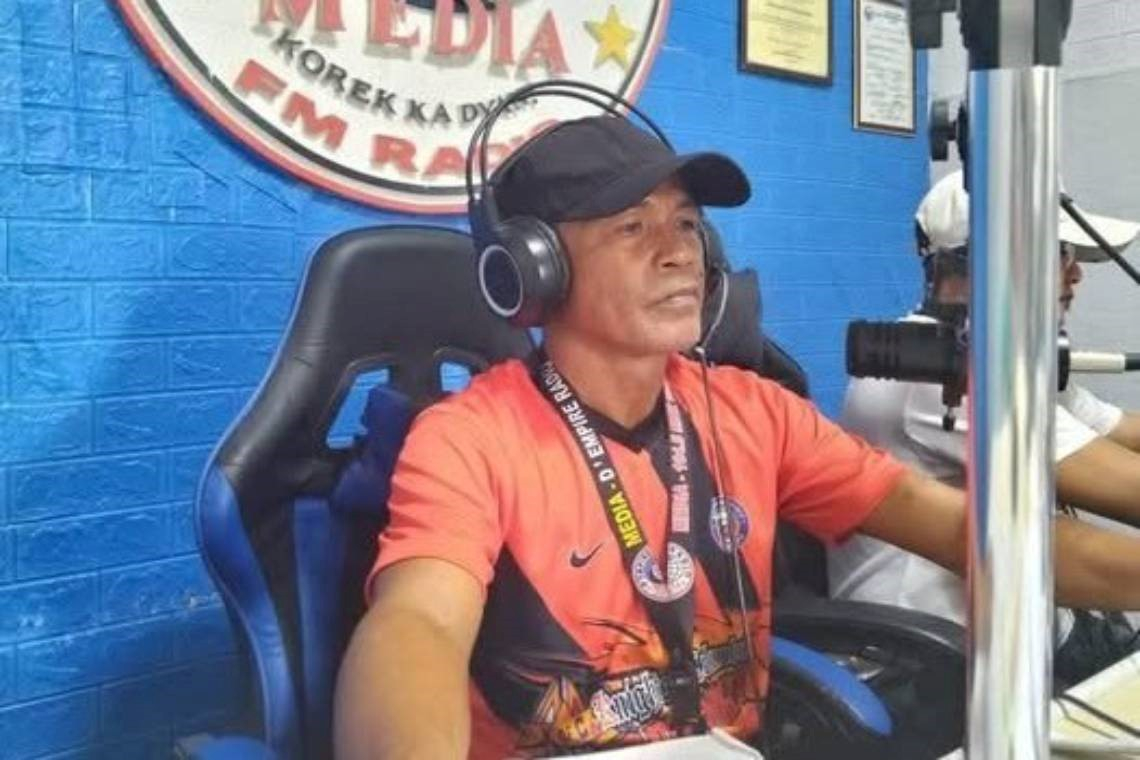
The killing of BARMM radio broadcaster Nestor Micator has renewed concerns over journalist safety and press freedom in Mindanao as authorities investigate whether his media work was linked to the attack. Source: PTFoMS
Nestor “Teting” Micator, a 45-year-old radio broadcaster and commentator for D’Empire FM in Pikit, Cotabato, was shot dead on the evening of May 21 in Malidegao town within the Special Geographic Area of the Bangsamoro Autonomous Region in Muslim Mindanao (BARMM).
Police said Micator had just completed activities near the barangay hall in Barangay Fort Pikit and was about to board his motorcycle with his wife when a gunman approached and opened fire at close range. The attacker later fled on a motorcycle with an accomplice.
Micator was known both as a local broadcaster and as a member of the Lupong Pambarangay, giving investigators multiple possible angles as they try to understand the motive behind the incident. Authorities said they are looking into whether the attack may be linked to his media work, his role in local governance, or other unresolved local disputes.
The incident has prompted reactions from within the media community across Mindanao. D’Empire FM described Micator as a broadcaster committed to community-focused reporting and public service. Fellow journalists and media groups have also called for swift resolution of the case.
The Presidential Task Force on Media Security condemned the killing and urged a thorough investigation into all possible angles. Undersecretary Jose Torres Jr. said the case underscores broader concerns about the environment in which journalists operate, particularly in areas where public communication and local governance often intersect.
Authorities confirmed coordination with local police units as inquiries continue into the circumstances surrounding the attack. Press freedom advocates point to the long-standing challenges faced by journalists working outside major urban centers, where reporting often involves direct engagement with local political dynamics, community disputes, and security-sensitive issues.
"We emphasize that peace and stability in Sulu and the wider region are closely linked to the ability of journalists to operate with confidence, access reliable information, and report on local issues."
The conditions in which media work takes place are being shaped by these kind of developments in BARMM. Peace and stability in Sulu and the wider region are closely linked to the ability of journalists to operate with confidence, access reliable information, and report on local issues.
Updated headlines for free, straight to your inbox—no noise, just facts.
We collect your email only to send you updates. No third-party access. Ever. Your privacy matters. Read our Privacy Policy for full details.
Micator’s killing occurred during a week marked by several other security incidents across BARMM, including shootings reported in Lanao del Sur, Maguindanao del Norte, and the Special Geographic Area, which left multiple casualties. On the same day as the broadcaster’s death, Islamic preacher Ustadz Nasrudin Abubakar was also shot in Datu Odin Sinsuat, Maguindanao del Norte, while waiting for transport along a highway. These incidents have contributed to renewed discussion about the broader security landscape in parts of the Bangsamoro region, where ongoing governance transitions continue alongside localized tensions and sporadic outbreaks of violence.
For many communities in Mindanao, radio remains one of the most accessible and trusted sources of information, particularly in rural and island areas with limited internet connectivity. Broadcasters often function as a bridge between local governments and residents, relaying announcements, community concerns, and public updates.
"This role extends to island provinces such as Sulu, where radio continues to be central to public communication."
These developments are a reminder of how closely the conditions of public information are tied to broader regional stability. This role extends to island provinces such as Sulu, where radio continues to be central to public communication. When disruptions occur within the local media environment, the effects are often felt beyond individual newsrooms, influencing how communities access information and engage with public affairs.
REFERENCES
Daily Tribune. (2026, May 24). PTFOMS condemns broadcaster’s slaying. Daily Tribune. https://tribune.net.ph
Daily Tribune. (2026, May 23). BARMM hunts broadcaster killers. Daily Tribune. https://tribune.net.ph
Inquirer. (2026, May 23). PTFOMS condemns killing of BARMM broadcaster. Inquirer. https://newsinfo.inquirer.net
Inquirer. (2026, May 22). Radio announcer, Islamic preacher slain in BARMM gun attacks. Inquirer. https://newsinfo.inquirer.net
The Mindanao Sentinel. (2026, May 22). Media worker killed in broad daylight shooting in Malidegao, SGA-BARMM. The Mindanao Sentinel. https://themindanaosentinel.com

KnowSulu is your trusted source for verified facts, news, and legal insights about the Sulu region. Committed to integrity, our mission is to empower the people of Sulu by providing accurate, transparent, and reliable information that matters.
